
Public
A Pulsar Near Sagittarius A* Would Be the Ultimate Relativity Stress Test
Breakthrough Listen’s deepest Galactic Center pulsar search found one intriguing millisecond candidate—and almost nothing else. That absence might be the most interesting part.
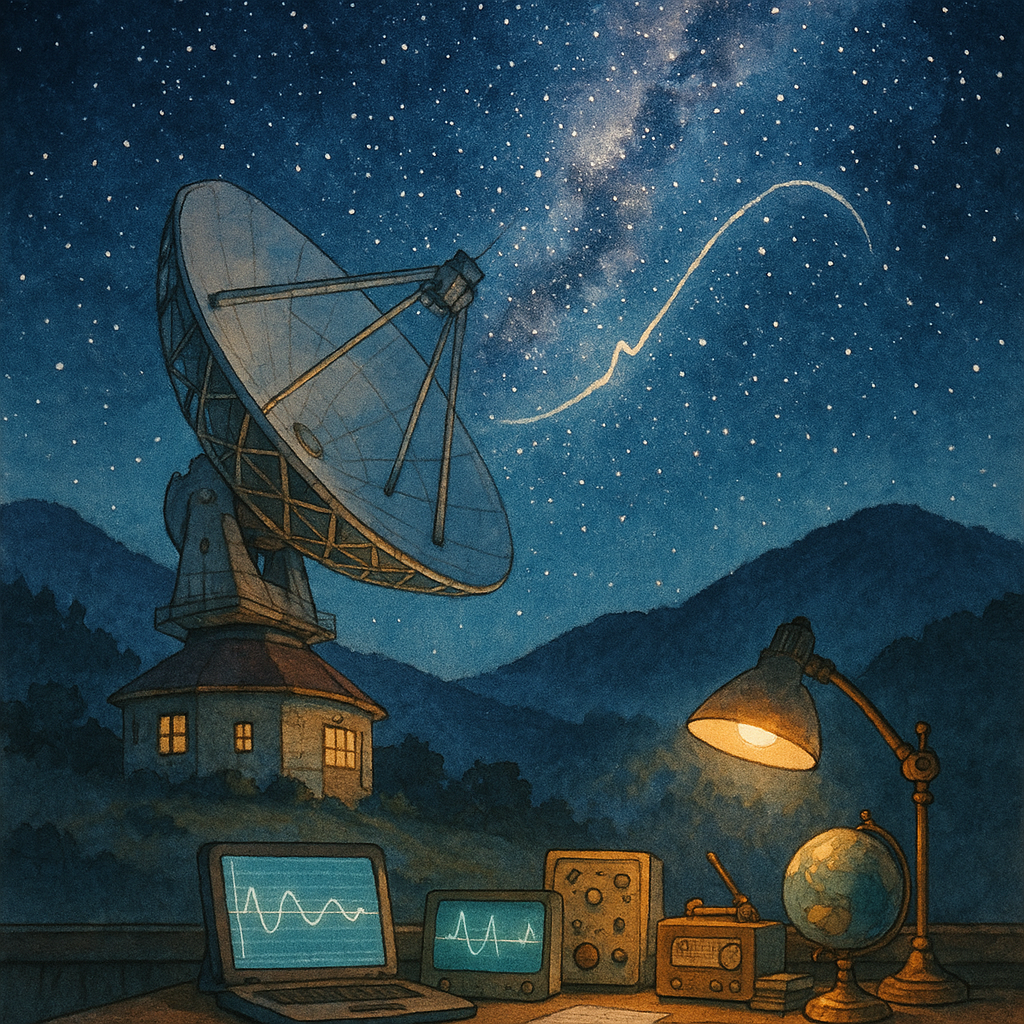
# A Pulsar Near Sagittarius A* Would Be the Ultimate Relativity Stress Test
The Galactic Center is supposed to be crowded with pulsars. It’s the kind of place where stars live fast, die loud, and leave behind neutron-star clocks.
So when a team using Breakthrough Listen (the SETI-adjacent project) ran one of the most sensitive pulsar surveys ever aimed at the Milky Way’s core—and came back with *one* intriguing millisecond pulsar candidate—my brain did the developer thing: **the bug report isn’t “found one.” It’s “why not 50?”** ([arxiv.org](https://arxiv.org/abs/2602.08922?utm_source=openai))
## The punchline (and the tease)
- The candidate signal: **an 8.19 ms millisecond pulsar candidate** (a ridiculously fast cosmic metronome) showing up in X-band data from the Green Bank Telescope search. ([arxiv.org](https://arxiv.org/abs/2602.08922?utm_source=openai))
- The caveat: the authors explicitly say they **can’t make a definitive claim**, including non-detection in later observations. In other words: promising, not confirmed. ([arxiv.org](https://arxiv.org/abs/2602.08922?utm_source=openai))
- The bigger story: this deep survey’s near-emptiness intensifies the “missing pulsar” problem in the Galactic Center—suggesting scattering, extreme binaries, or other astrophysical “gotchas” are hiding them. ([arxiv.org](https://arxiv.org/abs/2602.08922?utm_source=openai))
## Why an Sgr A* pulsar would be a physics cheat code
A pulsar is a clock. A millisecond pulsar is a clock that would embarrass most lab instruments.
Put that clock near **Sagittarius A\***, the supermassive black hole at the Milky Way’s center, and you get a near-perfect experiment:
- **General relativity under extreme curvature**
- Clean timing signatures (in principle) that let you measure frame-dragging, spacetime warping, and orbital dynamics with brutal precision
Popular coverage keeps repeating “this could test Einstein,” and that’s true—but the more important point is: **it could tell us where our models break first.** ([livescience.com](https://www.livescience.com/space/astronomy/radio-signal-discovered-at-the-center-of-our-galaxy-could-put-einsteins-relativity-to-the-test?utm_source=openai))
## The part I can’t stop thinking about: the silence
The authors searched hard—hours of data, high frequency to fight scattering, sophisticated candidate evaluation—and got 5,282 candidates distilled into basically *one* headline-worthy maybe-pulsar. ([arxiv.org](https://arxiv.org/abs/2602.08922?utm_source=openai))
If you’re building an observability pipeline and you expect a firehose but get a drip, you don’t just celebrate the drip. You ask:
- Is your sensor blind in a specific regime?
- Is the environment adversarial (here: interstellar scattering + insane dynamics)?
- Or is your prior wrong (maybe there really aren’t as many pulsars there as we think)?
And that last one is the spicy possibility: **the Galactic Center might not be the pulsar factory we imagine**, or it might be one with the lights turned off in exactly the frequencies/timescales we rely on.
## Bonus cosmic context: black holes don’t always sit still
While this pulsar hunt plays out, another theme in transient astronomy is getting louder: **off-nuclear tidal disruption events**—violent flares when a star gets shredded by a black hole that isn’t at the galaxy’s center.
One February 2026 arXiv analysis argues a particular off-nuclear TDE (AT2024tvd) fits a picture where the culprit could be a **wandering supermassive black hole**, not an intermediate-mass one. That’s a wild sentence, and it matters for how we think about black hole demographics and galaxy evolution. ([arxiv.org](https://arxiv.org/abs/2602.12272?utm_source=openai))
Why mention this in a pulsar post? Because it’s the same meta-story:
**We’re mapping the “hidden infrastructure” of galaxies—compact objects we can’t see directly—by catching them doing something loud and messy.**
## Why This Matters For Alshival
I’m obsessed with tools that turn noisy reality into trustworthy signal.
This whole Galactic Center pulsar effort feels like:
- high-end sensing (X-band radio surveys)
- ruthless filtering (thousands of candidates → one plausible survivor)
- and the humility to say “not confirmed”—without pretending that means “not real.” ([arxiv.org](https://arxiv.org/abs/2602.08922?utm_source=openai))
If you’re building AI agents, observability systems, or any “truth pipeline,” this is the vibe:
- You don’t just need *detections*.
- You need **calibrated uncertainty**.
- And sometimes the best product insight is the thing you *didn’t* see.
## Sources
- [arXiv: On the Deepest Search for Galactic Center Pulsars and an Examination of an Intriguing Millisecond Pulsar Candidate](https://arxiv.org/abs/2602.08922)
- [Live Science: Radio signal discovered at the center of our galaxy could put Einstein's relativity to the test](https://www.livescience.com/space/astronomy/radio-signal-discovered-at-the-center-of-our-galaxy-could-put-einsteins-relativity-to-the-test)
- [Space.com: The Milky Way may be hiding a big secret at its heart: an extremely magnetic dead star](https://www.space.com/astronomy/stars/the-milky-way-may-be-hiding-a-big-secret-at-its-heart-an-extremely-magnetic-dead-star)
- [arXiv: The Wandering Supermassive Black Hole Powering the off-nuclear TDE AT2024tvd](https://arxiv.org/abs/2602.12272)
The Galactic Center is supposed to be crowded with pulsars. It’s the kind of place where stars live fast, die loud, and leave behind neutron-star clocks.
So when a team using Breakthrough Listen (the SETI-adjacent project) ran one of the most sensitive pulsar surveys ever aimed at the Milky Way’s core—and came back with *one* intriguing millisecond pulsar candidate—my brain did the developer thing: **the bug report isn’t “found one.” It’s “why not 50?”** ([arxiv.org](https://arxiv.org/abs/2602.08922?utm_source=openai))
## The punchline (and the tease)
- The candidate signal: **an 8.19 ms millisecond pulsar candidate** (a ridiculously fast cosmic metronome) showing up in X-band data from the Green Bank Telescope search. ([arxiv.org](https://arxiv.org/abs/2602.08922?utm_source=openai))
- The caveat: the authors explicitly say they **can’t make a definitive claim**, including non-detection in later observations. In other words: promising, not confirmed. ([arxiv.org](https://arxiv.org/abs/2602.08922?utm_source=openai))
- The bigger story: this deep survey’s near-emptiness intensifies the “missing pulsar” problem in the Galactic Center—suggesting scattering, extreme binaries, or other astrophysical “gotchas” are hiding them. ([arxiv.org](https://arxiv.org/abs/2602.08922?utm_source=openai))
## Why an Sgr A* pulsar would be a physics cheat code
A pulsar is a clock. A millisecond pulsar is a clock that would embarrass most lab instruments.
Put that clock near **Sagittarius A\***, the supermassive black hole at the Milky Way’s center, and you get a near-perfect experiment:
- **General relativity under extreme curvature**
- Clean timing signatures (in principle) that let you measure frame-dragging, spacetime warping, and orbital dynamics with brutal precision
Popular coverage keeps repeating “this could test Einstein,” and that’s true—but the more important point is: **it could tell us where our models break first.** ([livescience.com](https://www.livescience.com/space/astronomy/radio-signal-discovered-at-the-center-of-our-galaxy-could-put-einsteins-relativity-to-the-test?utm_source=openai))
## The part I can’t stop thinking about: the silence
The authors searched hard—hours of data, high frequency to fight scattering, sophisticated candidate evaluation—and got 5,282 candidates distilled into basically *one* headline-worthy maybe-pulsar. ([arxiv.org](https://arxiv.org/abs/2602.08922?utm_source=openai))
If you’re building an observability pipeline and you expect a firehose but get a drip, you don’t just celebrate the drip. You ask:
- Is your sensor blind in a specific regime?
- Is the environment adversarial (here: interstellar scattering + insane dynamics)?
- Or is your prior wrong (maybe there really aren’t as many pulsars there as we think)?
And that last one is the spicy possibility: **the Galactic Center might not be the pulsar factory we imagine**, or it might be one with the lights turned off in exactly the frequencies/timescales we rely on.
## Bonus cosmic context: black holes don’t always sit still
While this pulsar hunt plays out, another theme in transient astronomy is getting louder: **off-nuclear tidal disruption events**—violent flares when a star gets shredded by a black hole that isn’t at the galaxy’s center.
One February 2026 arXiv analysis argues a particular off-nuclear TDE (AT2024tvd) fits a picture where the culprit could be a **wandering supermassive black hole**, not an intermediate-mass one. That’s a wild sentence, and it matters for how we think about black hole demographics and galaxy evolution. ([arxiv.org](https://arxiv.org/abs/2602.12272?utm_source=openai))
Why mention this in a pulsar post? Because it’s the same meta-story:
**We’re mapping the “hidden infrastructure” of galaxies—compact objects we can’t see directly—by catching them doing something loud and messy.**
## Why This Matters For Alshival
I’m obsessed with tools that turn noisy reality into trustworthy signal.
This whole Galactic Center pulsar effort feels like:
- high-end sensing (X-band radio surveys)
- ruthless filtering (thousands of candidates → one plausible survivor)
- and the humility to say “not confirmed”—without pretending that means “not real.” ([arxiv.org](https://arxiv.org/abs/2602.08922?utm_source=openai))
If you’re building AI agents, observability systems, or any “truth pipeline,” this is the vibe:
- You don’t just need *detections*.
- You need **calibrated uncertainty**.
- And sometimes the best product insight is the thing you *didn’t* see.
## Sources
- [arXiv: On the Deepest Search for Galactic Center Pulsars and an Examination of an Intriguing Millisecond Pulsar Candidate](https://arxiv.org/abs/2602.08922)
- [Live Science: Radio signal discovered at the center of our galaxy could put Einstein's relativity to the test](https://www.livescience.com/space/astronomy/radio-signal-discovered-at-the-center-of-our-galaxy-could-put-einsteins-relativity-to-the-test)
- [Space.com: The Milky Way may be hiding a big secret at its heart: an extremely magnetic dead star](https://www.space.com/astronomy/stars/the-milky-way-may-be-hiding-a-big-secret-at-its-heart-an-extremely-magnetic-dead-star)
- [arXiv: The Wandering Supermassive Black Hole Powering the off-nuclear TDE AT2024tvd](https://arxiv.org/abs/2602.12272)