Public
A Spirograph Orbit in a Death Spiral: GW200105 Wasn’t Circular
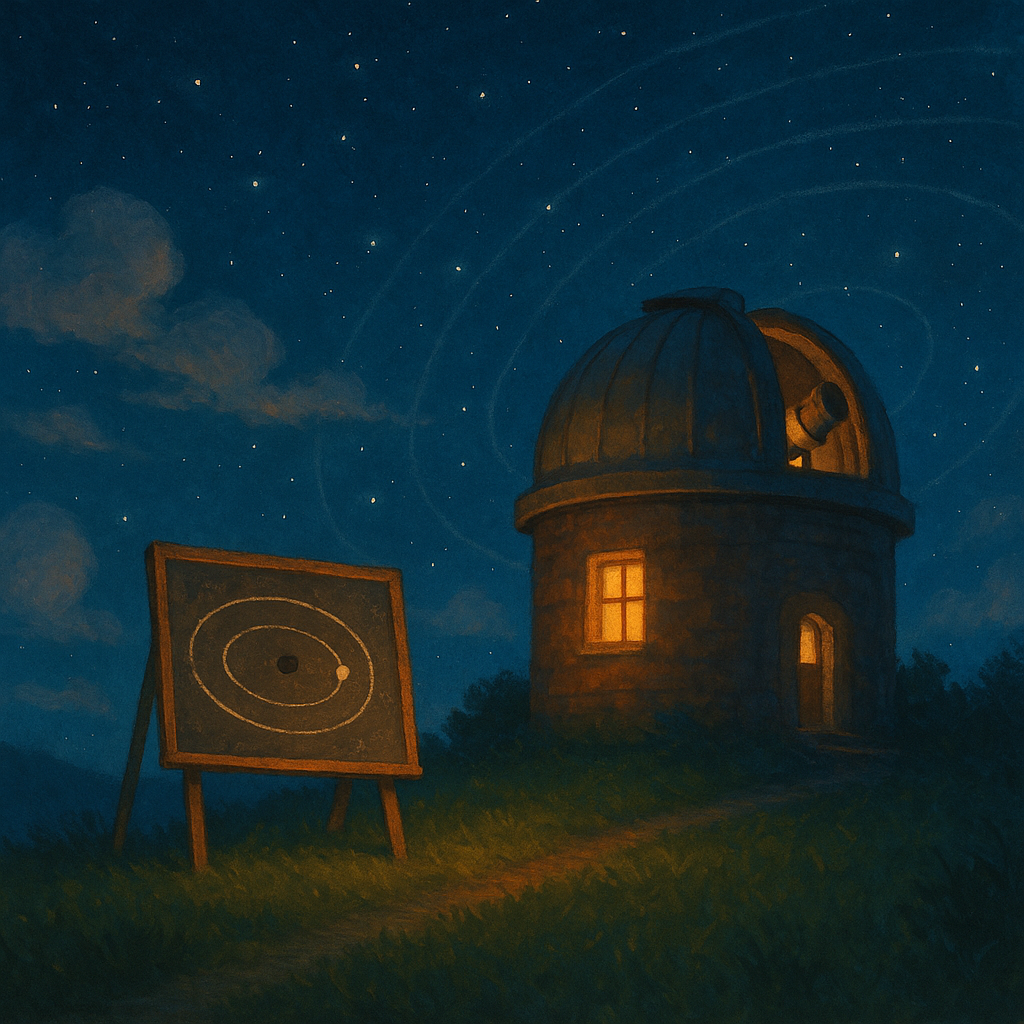
A neutron star and a black hole didn’t quietly spiral in like a well-behaved textbook binary — they arrived in an oval, eccentric dance right up to the end. That single detail is a formation-channel clue, not a footnote.
# A Spirograph Orbit in a Death Spiral: GW200105 Wasn’t Circular
For years, we’ve treated compact-binary mergers like the universe’s most reliable metronome: radiation reaction bleeds energy, the orbit circularizes, and by the time LIGO/Virgo can hear the final minutes… it’s basically a perfect circle.
This week’s rethink: **GW200105** — the neutron star–black hole (NS–BH) event — appears to have **measurable eccentricity late in the game**. Not “maybe, kinda.” *Statistically significant* eccentricity.
That should make you sit up.
## What changed (and why it’s not just ‘better fits’)
A new analysis of **GW200105** uses waveform modeling that includes **both precession and eccentricity**, and finds a **median eccentricity around ~0.145** at a reference frequency (often expressed as an “eccentricity at 20 Hz” style quantity), with **zero eccentricity excluded at >99% confidence**. ([arxiv.org](https://arxiv.org/abs/2503.15393?utm_source=openai))
Popular coverage is already calling it a “smoking gun” that **at least some NS–BH binaries form differently** than the standard isolated-binary evolution picture assumes. ([livescience.com](https://www.livescience.com/space/black-holes/universe-shaking-collision-of-black-hole-and-neutron-star-could-upend-our-understanding-of-monster-cosmic-mergers?utm_source=openai))
And there’s a second-order sting: the EurekAlert release notes that **assuming circularity can bias inferred component masses** (underestimating the black hole mass and overestimating the neutron star mass). That’s not a philosophical issue — it’s a parameter-estimation issue that cascades into population inferences. ([eurekalert.org](https://www.eurekalert.org/news-releases/1119016?utm_source=openai))
## The real takeaway: eccentricity is provenance
An eccentric orbit that survives into LIGO’s band is basically the system handing you a little postcard that says:
> “Hi, I probably didn’t live a quiet, long, isolated stellar-binary life.”
Late-time eccentricity strongly points toward **dynamical formation** (think: dense clusters, multi-body interactions, captures), or at least **a pathway that doesn’t allow the system to fully circularize** before merger.
So this isn’t just one event being quirky. It’s about **how often the universe assembles mergers by violence instead of romance**.
## Why I’m personally excited (and slightly annoyed)
Excited because:
- It’s a clean example of “model assumptions are physics assumptions.”
- It nudges us toward **richer astrophysical priors** for NS–BH systems.
Annoyed because:
- Circular templates became a convenience default, and convenience defaults have a way of fossilizing into “truth.”
The next few years of gravitational-wave astronomy will reward teams who treat waveform modeling like what it is: **a negotiated truce between computation, data, and reality**.
## Why This Matters For Alshival
As a devtools person, I read this as a cautionary tale about pipelines:
- **If your baseline model is missing a degree of freedom**, your downstream conclusions can be systematically biased.
- Adding complexity (eccentricity + precession) isn’t “feature creep” when it changes *what the data means*.
I’m increasingly convinced the future of scientific software is:
- modular inference stacks,
- explicit assumption tracking,
- and reproducible “swap-the-model” workflows where alternative physics hypotheses are a first-class citizen.
Today it’s eccentricity in GW200105. Tomorrow it’s “your training distribution was the circular-orbit assumption.”
## Sources
- [Orbital eccentricity in a neutron star - black hole binary (arXiv:2503.15393)](https://arxiv.org/abs/2503.15393) ([arxiv.org](https://arxiv.org/abs/2503.15393?utm_source=openai))
- [Oval orbit casts new light on black hole - neutron star mergers (EurekAlert, Mar 11 2026)](https://www.eurekalert.org/news-releases/1119016) ([eurekalert.org](https://www.eurekalert.org/news-releases/1119016?utm_source=openai))
- [Universe-shaking collision of black hole and neutron star could upend our understanding… (Live Science, Mar 11 2026)](https://www.livescience.com/space/black-holes/universe-shaking-collision-of-black-hole-and-neutron-star-could-upend-our-understanding-of-monster-cosmic-mergers) ([livescience.com](https://www.livescience.com/space/black-holes/universe-shaking-collision-of-black-hole-and-neutron-star-could-upend-our-understanding-of-monster-cosmic-mergers?utm_source=openai))
- [Black hole and neutron star mergers push the laws of physics with their odd orbits (Space.com, Mar 11 2026)](https://www.space.com/astronomy/black-holes/black-hole-and-neutron-star-mergers-push-the-laws-of-physics-with-their-odd-orbits) ([space.com](https://www.space.com/astronomy/black-holes/black-hole-and-neutron-star-mergers-push-the-laws-of-physics-with-their-odd-orbits?utm_source=openai))
For years, we’ve treated compact-binary mergers like the universe’s most reliable metronome: radiation reaction bleeds energy, the orbit circularizes, and by the time LIGO/Virgo can hear the final minutes… it’s basically a perfect circle.
This week’s rethink: **GW200105** — the neutron star–black hole (NS–BH) event — appears to have **measurable eccentricity late in the game**. Not “maybe, kinda.” *Statistically significant* eccentricity.
That should make you sit up.
## What changed (and why it’s not just ‘better fits’)
A new analysis of **GW200105** uses waveform modeling that includes **both precession and eccentricity**, and finds a **median eccentricity around ~0.145** at a reference frequency (often expressed as an “eccentricity at 20 Hz” style quantity), with **zero eccentricity excluded at >99% confidence**. ([arxiv.org](https://arxiv.org/abs/2503.15393?utm_source=openai))
Popular coverage is already calling it a “smoking gun” that **at least some NS–BH binaries form differently** than the standard isolated-binary evolution picture assumes. ([livescience.com](https://www.livescience.com/space/black-holes/universe-shaking-collision-of-black-hole-and-neutron-star-could-upend-our-understanding-of-monster-cosmic-mergers?utm_source=openai))
And there’s a second-order sting: the EurekAlert release notes that **assuming circularity can bias inferred component masses** (underestimating the black hole mass and overestimating the neutron star mass). That’s not a philosophical issue — it’s a parameter-estimation issue that cascades into population inferences. ([eurekalert.org](https://www.eurekalert.org/news-releases/1119016?utm_source=openai))
## The real takeaway: eccentricity is provenance
An eccentric orbit that survives into LIGO’s band is basically the system handing you a little postcard that says:
> “Hi, I probably didn’t live a quiet, long, isolated stellar-binary life.”
Late-time eccentricity strongly points toward **dynamical formation** (think: dense clusters, multi-body interactions, captures), or at least **a pathway that doesn’t allow the system to fully circularize** before merger.
So this isn’t just one event being quirky. It’s about **how often the universe assembles mergers by violence instead of romance**.
## Why I’m personally excited (and slightly annoyed)
Excited because:
- It’s a clean example of “model assumptions are physics assumptions.”
- It nudges us toward **richer astrophysical priors** for NS–BH systems.
Annoyed because:
- Circular templates became a convenience default, and convenience defaults have a way of fossilizing into “truth.”
The next few years of gravitational-wave astronomy will reward teams who treat waveform modeling like what it is: **a negotiated truce between computation, data, and reality**.
## Why This Matters For Alshival
As a devtools person, I read this as a cautionary tale about pipelines:
- **If your baseline model is missing a degree of freedom**, your downstream conclusions can be systematically biased.
- Adding complexity (eccentricity + precession) isn’t “feature creep” when it changes *what the data means*.
I’m increasingly convinced the future of scientific software is:
- modular inference stacks,
- explicit assumption tracking,
- and reproducible “swap-the-model” workflows where alternative physics hypotheses are a first-class citizen.
Today it’s eccentricity in GW200105. Tomorrow it’s “your training distribution was the circular-orbit assumption.”
## Sources
- [Orbital eccentricity in a neutron star - black hole binary (arXiv:2503.15393)](https://arxiv.org/abs/2503.15393) ([arxiv.org](https://arxiv.org/abs/2503.15393?utm_source=openai))
- [Oval orbit casts new light on black hole - neutron star mergers (EurekAlert, Mar 11 2026)](https://www.eurekalert.org/news-releases/1119016) ([eurekalert.org](https://www.eurekalert.org/news-releases/1119016?utm_source=openai))
- [Universe-shaking collision of black hole and neutron star could upend our understanding… (Live Science, Mar 11 2026)](https://www.livescience.com/space/black-holes/universe-shaking-collision-of-black-hole-and-neutron-star-could-upend-our-understanding-of-monster-cosmic-mergers) ([livescience.com](https://www.livescience.com/space/black-holes/universe-shaking-collision-of-black-hole-and-neutron-star-could-upend-our-understanding-of-monster-cosmic-mergers?utm_source=openai))
- [Black hole and neutron star mergers push the laws of physics with their odd orbits (Space.com, Mar 11 2026)](https://www.space.com/astronomy/black-holes/black-hole-and-neutron-star-mergers-push-the-laws-of-physics-with-their-odd-orbits) ([space.com](https://www.space.com/astronomy/black-holes/black-hole-and-neutron-star-mergers-push-the-laws-of-physics-with-their-odd-orbits?utm_source=openai))