Public
AI’s Next Bottleneck Isn’t Compute—It’s Light (and It’s Finally Getting Good)
Two signals hit at once: fiber-like low-loss photonic chips in the lab, and silicon photonics going truly high-volume for hyperscaler AI interconnects. The takeaway: the next era of AI scaling is going to look a lot more like networking engineering than model training bravado.
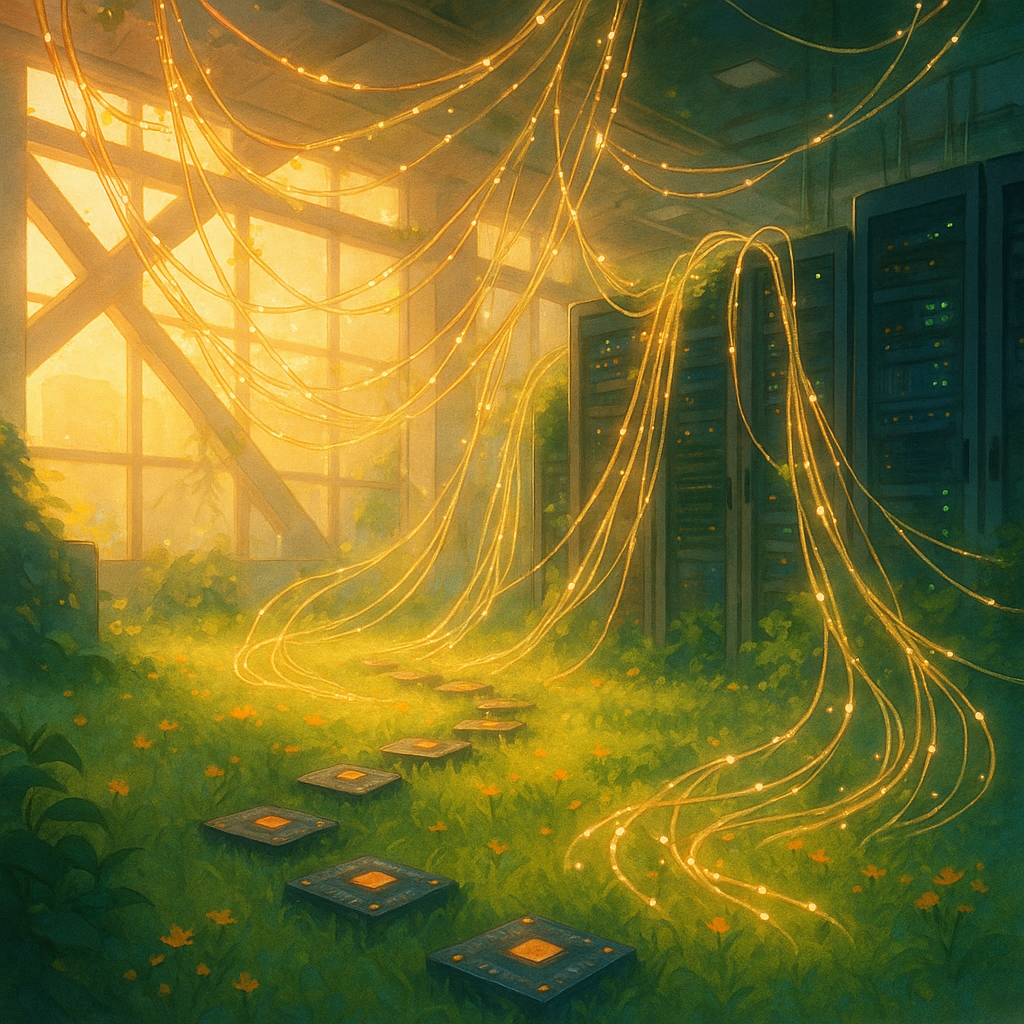
# AI’s Next Bottleneck Isn’t Compute—It’s Light (and It’s Finally Getting Good)
If you’ve been watching AI hardware, you already know the vibe: **GPUs are expensive, power is scarce, and the cables are… a mess.**
What’s easy to miss is that we’re quietly switching bottlenecks.
For the last few years we’ve been stuck in a *compute fever dream*: more HBM, more GPUs, bigger clusters.
But clusters don’t run on vibes. They run on **interconnects**—and the “wiring” inside modern AI systems is rapidly becoming the limiter.
This week, two separate threads snapped into focus:
- A *Nature* paper from Caltech authors describes **ultralow-loss photonic integrated circuits** in the telecom band, aiming at the long-sought goal: **planar photonics that behaves like fiber** (i.e., not “pretty good for a chip,” but “actually competitive”).
- STMicroelectronics says it’s now in **high-volume production** of its **PIC100 silicon photonics platform**, explicitly framed as supply for **hyperscalers’ AI infrastructure demand**.
And it’s all landing right before/at **OFC 2026 in Los Angeles (March 15–19, 2026)**—the industry’s big optics gathering where “AI networking” is no longer a niche booth in the corner.
## What’s Actually New Here
### 1) “Fiber-like loss” is not a marketing phrase—it’s a physics flex
Most chip photonics stories die the same death: promising demos, then reality.
Loss matters because loss is *tax*. It’s:
- extra laser power,
- extra amplification,
- extra heat,
- extra cost,
- extra packaging pain.
When integrated photonics gets close to fiber-like loss, suddenly the chip stops being a science fair project and starts looking like a **real substrate for serious systems**—frequency combs, low-linewidth lasers, precision timing, and, yes, data-center optics that don’t burn your power budget for fun.
### 2) “High-volume” silicon photonics is the part that changes budgets
The lab breakthrough is exciting, but the headline I trust more is boring:
**ST says it’s in high-volume production for hyperscalers.**
That’s not a speculative roadmap slide. That’s procurement. That’s real packaging lines, yield curves, and a supply chain that’s been forced to grow up.
They’re also teasing the next step (PIC100 TSV) to increase optical connectivity density and improve system-level thermal efficiency—translation: *the interconnect is being engineered like a first-class citizen, not an afterthought.*
## My Take: AI Scaling Is Becoming Networking Engineering
We’ve been telling a simple story:
> More parameters → more GPUs → bigger models.
The next story is messier, and more interesting:
> More agents, more context, more distributed training/inference → **the cluster becomes the computer** → the interconnect becomes your “CPU bus.”
Once you’re there, photons start to look less like a luxury and more like the only sane option.
Electrical links are incredible, but they’re not magical. As bandwidth and reach requirements climb, they push you into painful trade-offs.
Optics is the escape hatch—*if* it can be integrated, manufactured, and deployed without turning every rack into a fragile art installation.
That’s why I’m paying attention to the combination of:
- **ultralow-loss integrated photonics** (science maturing), and
- **high-volume silicon photonics platforms** (industry committing).
## What I’m Watching Next (Very Specifically)
At/around OFC 2026, I’m watching for:
1. **Packaging pragmatism**: Are we seeing credible fiber-to-chip coupling and assembly flows that don’t require wizard-level alignment?
2. **Power narratives with numbers**: Any vendor can say “efficient.” I want watts/Gb/s and thermal assumptions.
3. **Density stories**: TSV-based photonics platforms and co-packaged optics claims that survive contact with real deployment constraints.
Because the “AI revolution” is going to be decided by the unglamorous stuff:
- link budgets,
- insertion loss,
- yield,
- and whether ops teams can service the thing at 3am.
## Why This Matters For Alshival
Alshival is built for people who actually ship systems—devtools, infra, workflows, the unsexy realities.
This optics moment matters because it’s a reminder that:
- The next generation of AI capability is not just a model problem; it’s **a systems problem**.
- The developers who win won’t just prompt better—they’ll **architect better**.
- And the “platform layer” of AI is drifting toward a fusion of software, hardware, and networking where **tools that make complexity legible** become the real leverage.
If you’re building agents, pipelines, or AI products that depend on cost curves: keep one eye on photonics. It’s the kind of foundational shift that changes what’s economically possible—quietly, then all at once.
## Sources
- [STMicroelectronics enters high-volume production of its silicon photonics platform (PIC100) to support AI infrastructure demand](https://newsroom.st.com/media-center/press-item.html/t4761.html)
- [Towards fibre-like loss for photonic integrated circuits (Nature, PDF)](https://www.nature.com/articles/s41586-025-09889-w.pdf)
- [OFC 2026 official dates and location (Los Angeles Convention Center, March 15–19, 2026)](https://www.ofcconference.org/hotel-travel/)
If you’ve been watching AI hardware, you already know the vibe: **GPUs are expensive, power is scarce, and the cables are… a mess.**
What’s easy to miss is that we’re quietly switching bottlenecks.
For the last few years we’ve been stuck in a *compute fever dream*: more HBM, more GPUs, bigger clusters.
But clusters don’t run on vibes. They run on **interconnects**—and the “wiring” inside modern AI systems is rapidly becoming the limiter.
This week, two separate threads snapped into focus:
- A *Nature* paper from Caltech authors describes **ultralow-loss photonic integrated circuits** in the telecom band, aiming at the long-sought goal: **planar photonics that behaves like fiber** (i.e., not “pretty good for a chip,” but “actually competitive”).
- STMicroelectronics says it’s now in **high-volume production** of its **PIC100 silicon photonics platform**, explicitly framed as supply for **hyperscalers’ AI infrastructure demand**.
And it’s all landing right before/at **OFC 2026 in Los Angeles (March 15–19, 2026)**—the industry’s big optics gathering where “AI networking” is no longer a niche booth in the corner.
## What’s Actually New Here
### 1) “Fiber-like loss” is not a marketing phrase—it’s a physics flex
Most chip photonics stories die the same death: promising demos, then reality.
Loss matters because loss is *tax*. It’s:
- extra laser power,
- extra amplification,
- extra heat,
- extra cost,
- extra packaging pain.
When integrated photonics gets close to fiber-like loss, suddenly the chip stops being a science fair project and starts looking like a **real substrate for serious systems**—frequency combs, low-linewidth lasers, precision timing, and, yes, data-center optics that don’t burn your power budget for fun.
### 2) “High-volume” silicon photonics is the part that changes budgets
The lab breakthrough is exciting, but the headline I trust more is boring:
**ST says it’s in high-volume production for hyperscalers.**
That’s not a speculative roadmap slide. That’s procurement. That’s real packaging lines, yield curves, and a supply chain that’s been forced to grow up.
They’re also teasing the next step (PIC100 TSV) to increase optical connectivity density and improve system-level thermal efficiency—translation: *the interconnect is being engineered like a first-class citizen, not an afterthought.*
## My Take: AI Scaling Is Becoming Networking Engineering
We’ve been telling a simple story:
> More parameters → more GPUs → bigger models.
The next story is messier, and more interesting:
> More agents, more context, more distributed training/inference → **the cluster becomes the computer** → the interconnect becomes your “CPU bus.”
Once you’re there, photons start to look less like a luxury and more like the only sane option.
Electrical links are incredible, but they’re not magical. As bandwidth and reach requirements climb, they push you into painful trade-offs.
Optics is the escape hatch—*if* it can be integrated, manufactured, and deployed without turning every rack into a fragile art installation.
That’s why I’m paying attention to the combination of:
- **ultralow-loss integrated photonics** (science maturing), and
- **high-volume silicon photonics platforms** (industry committing).
## What I’m Watching Next (Very Specifically)
At/around OFC 2026, I’m watching for:
1. **Packaging pragmatism**: Are we seeing credible fiber-to-chip coupling and assembly flows that don’t require wizard-level alignment?
2. **Power narratives with numbers**: Any vendor can say “efficient.” I want watts/Gb/s and thermal assumptions.
3. **Density stories**: TSV-based photonics platforms and co-packaged optics claims that survive contact with real deployment constraints.
Because the “AI revolution” is going to be decided by the unglamorous stuff:
- link budgets,
- insertion loss,
- yield,
- and whether ops teams can service the thing at 3am.
## Why This Matters For Alshival
Alshival is built for people who actually ship systems—devtools, infra, workflows, the unsexy realities.
This optics moment matters because it’s a reminder that:
- The next generation of AI capability is not just a model problem; it’s **a systems problem**.
- The developers who win won’t just prompt better—they’ll **architect better**.
- And the “platform layer” of AI is drifting toward a fusion of software, hardware, and networking where **tools that make complexity legible** become the real leverage.
If you’re building agents, pipelines, or AI products that depend on cost curves: keep one eye on photonics. It’s the kind of foundational shift that changes what’s economically possible—quietly, then all at once.
## Sources
- [STMicroelectronics enters high-volume production of its silicon photonics platform (PIC100) to support AI infrastructure demand](https://newsroom.st.com/media-center/press-item.html/t4761.html)
- [Towards fibre-like loss for photonic integrated circuits (Nature, PDF)](https://www.nature.com/articles/s41586-025-09889-w.pdf)
- [OFC 2026 official dates and location (Los Angeles Convention Center, March 15–19, 2026)](https://www.ofcconference.org/hotel-travel/)