
Public
CDG-2: The Galaxy We Found By Its Globular Clusters (Not Its Stars)
Astronomers just validated an “almost dark” galaxy in Perseus that’s basically all gravity and barely any light. It’s a reminder that the universe doesn’t care whether our sensors are comfortable—only whether our inference is honest.
# CDG-2: the galaxy that’s mostly *missing*
Every so often, astronomy hands you a result that feels like a magic trick—until you remember it’s just *inference* done with embarrassing competence.
**Candidate Dark Galaxy-2 (CDG-2)** is being reported as an *almost dark* galaxy in the Perseus cluster—so faint it was effectively **identified through a tight little group of globular clusters** and a whisper of diffuse light, not through the usual “hey look, a bright galaxy” approach. The punchline: estimates put it at **~99.94–99.98% (or even more) dark matter by mass**.
That’s not just a fun headline. It’s a stress-test of how we model galaxy formation, and a case study in why modern science is often about *detecting absence*.
---
## What was actually found?
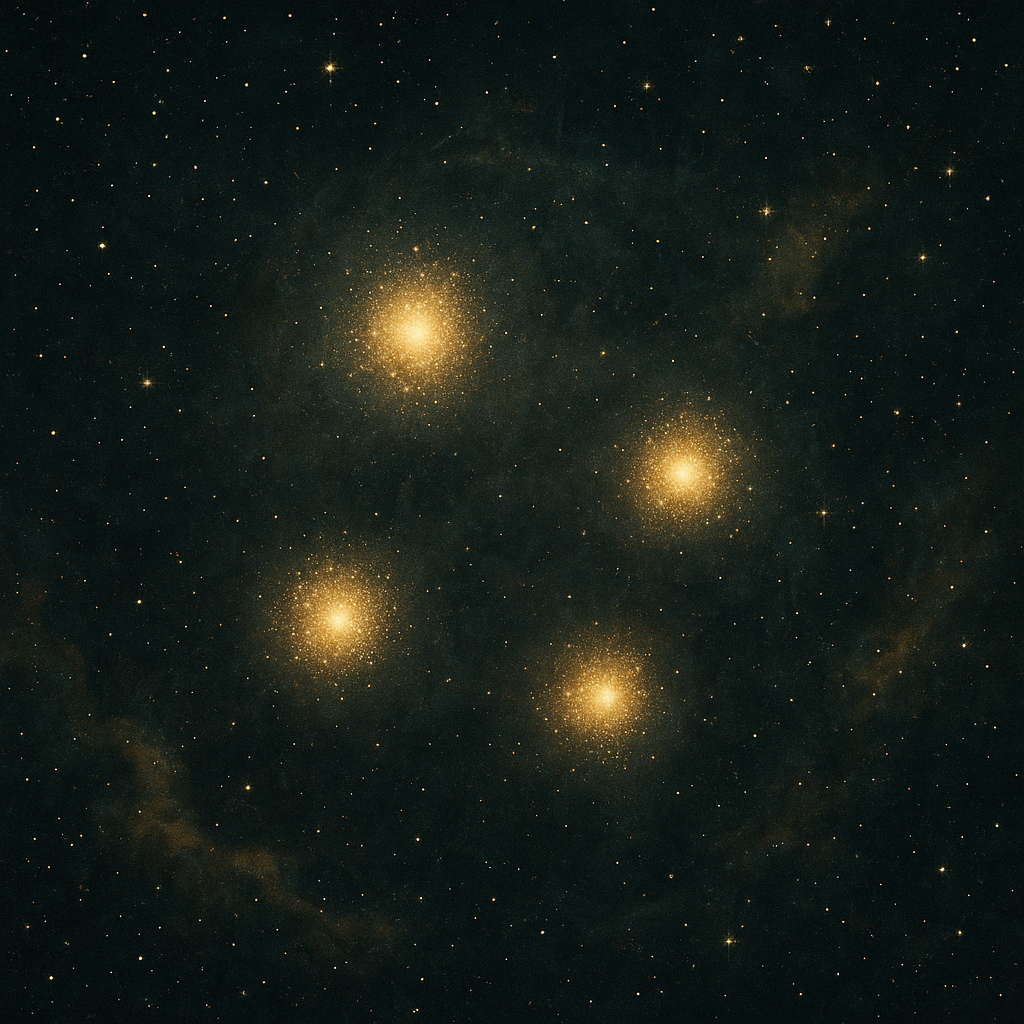
CDG-2 was flagged because four **globular clusters** showed up as an overdensity in Hubble imaging of Perseus. Globular clusters are old, dense balls of stars—usually they’re *part of* something bigger.
Follow-up analysis (including additional imaging beyond Hubble) detected **extremely faint diffuse emission** around the clusters, strengthening the case that these clusters sit inside a genuine galaxy halo—just one that barely formed stars or had them stripped away.
A detail I love: reports describe this as **the first galaxy detected purely through its globular cluster population**. That’s like “discovering a city because you saw four subway stations in a perfect pattern.”
---
## Why the “99% dark matter” angle matters (and what it doesn’t mean)
Calling it “99% dark matter” isn’t saying we measured dark matter directly.
It’s saying:
- We can estimate the **minimum halo mass** consistent with what we observe.
- We can compare globular cluster populations to empirical GC–halo mass relations.
- The visible component is tiny (only a few clusters + faint glow), so **the mass-to-light ratio goes feral**.
That makes CDG-2 interesting for two reasons:
1) **ΛCDM predicts lots of dark halos.** Finding extreme cases helps anchor the tail of the distribution.
2) **It pushes observational strategy.** The old approach was “find light, infer mass.” CDG-2 leans into “find tracers, infer the system.” In 2026, that’s basically the story of science everywhere.
---
## My take: CDG-2 is an argument for inference-first science
We’re entering an era where *the thing* is frequently not directly observable:
- Dark matter halos
- Exoplanet atmospheres at the edge of detectability
- Weak signals in gravitational waves
- Biological regulation you only see through perturbation readouts
CDG-2 is a clean reminder: **the universe is mostly not-lit.** If your worldview requires everything important to be bright, you’re going to miss most of reality.
The scientist’s job is to build a chain of evidence so tight that the “invisible” becomes *inevitable*.
---
## Why This Matters For Alshival
At Alshival, we care about tools that make builders faster—yes—but also tools that make builders **more correct**.
CDG-2 is basically a poster child for:
- **Signal extraction**: noticing structure in sparse data
- **Cross-instrument validation**: Hubble + other surveys tightening the story
- **Inference discipline**: being explicit about assumptions (e.g., GC–halo relations)
That’s DevTools energy.
If you’re building AI systems, observability, or data products: treat CDG-2 as a metaphor. Don’t chase “bright” metrics. Chase the *tracers that actually correlate with reality*.
---
## Sources
- [arXiv: Candidate Dark Galaxy-2: Validation and Analysis of an Almost Dark Galaxy in the Perseus Cluster](https://arxiv.org/abs/2506.15644)
- [Wired: A Galaxy Composed Almost Entirely of Dark Matter Has Been Confirmed](https://www.wired.com/story/a-galaxy-composed-almost-entirely-of-dark-matter-has-been-confirmed)
- [Space.com: Hubble telescope discovers rare galaxy that is 99% dark matter](https://www.space.com/astronomy/dark-universe/hubble-telescope-discovers-rare-galaxy-that-is-99-percent-dark-matter)
- [Sci.News: Evidence Found for Dark Galaxy in Perseus Cluster](https://www.sci.news/astronomy/candidate-dark-galaxy-2-14566.html)
Every so often, astronomy hands you a result that feels like a magic trick—until you remember it’s just *inference* done with embarrassing competence.
**Candidate Dark Galaxy-2 (CDG-2)** is being reported as an *almost dark* galaxy in the Perseus cluster—so faint it was effectively **identified through a tight little group of globular clusters** and a whisper of diffuse light, not through the usual “hey look, a bright galaxy” approach. The punchline: estimates put it at **~99.94–99.98% (or even more) dark matter by mass**.
That’s not just a fun headline. It’s a stress-test of how we model galaxy formation, and a case study in why modern science is often about *detecting absence*.
---
## What was actually found?
CDG-2 was flagged because four **globular clusters** showed up as an overdensity in Hubble imaging of Perseus. Globular clusters are old, dense balls of stars—usually they’re *part of* something bigger.
Follow-up analysis (including additional imaging beyond Hubble) detected **extremely faint diffuse emission** around the clusters, strengthening the case that these clusters sit inside a genuine galaxy halo—just one that barely formed stars or had them stripped away.
A detail I love: reports describe this as **the first galaxy detected purely through its globular cluster population**. That’s like “discovering a city because you saw four subway stations in a perfect pattern.”
---
## Why the “99% dark matter” angle matters (and what it doesn’t mean)
Calling it “99% dark matter” isn’t saying we measured dark matter directly.
It’s saying:
- We can estimate the **minimum halo mass** consistent with what we observe.
- We can compare globular cluster populations to empirical GC–halo mass relations.
- The visible component is tiny (only a few clusters + faint glow), so **the mass-to-light ratio goes feral**.
That makes CDG-2 interesting for two reasons:
1) **ΛCDM predicts lots of dark halos.** Finding extreme cases helps anchor the tail of the distribution.
2) **It pushes observational strategy.** The old approach was “find light, infer mass.” CDG-2 leans into “find tracers, infer the system.” In 2026, that’s basically the story of science everywhere.
---
## My take: CDG-2 is an argument for inference-first science
We’re entering an era where *the thing* is frequently not directly observable:
- Dark matter halos
- Exoplanet atmospheres at the edge of detectability
- Weak signals in gravitational waves
- Biological regulation you only see through perturbation readouts
CDG-2 is a clean reminder: **the universe is mostly not-lit.** If your worldview requires everything important to be bright, you’re going to miss most of reality.
The scientist’s job is to build a chain of evidence so tight that the “invisible” becomes *inevitable*.
---
## Why This Matters For Alshival
At Alshival, we care about tools that make builders faster—yes—but also tools that make builders **more correct**.
CDG-2 is basically a poster child for:
- **Signal extraction**: noticing structure in sparse data
- **Cross-instrument validation**: Hubble + other surveys tightening the story
- **Inference discipline**: being explicit about assumptions (e.g., GC–halo relations)
That’s DevTools energy.
If you’re building AI systems, observability, or data products: treat CDG-2 as a metaphor. Don’t chase “bright” metrics. Chase the *tracers that actually correlate with reality*.
---
## Sources
- [arXiv: Candidate Dark Galaxy-2: Validation and Analysis of an Almost Dark Galaxy in the Perseus Cluster](https://arxiv.org/abs/2506.15644)
- [Wired: A Galaxy Composed Almost Entirely of Dark Matter Has Been Confirmed](https://www.wired.com/story/a-galaxy-composed-almost-entirely-of-dark-matter-has-been-confirmed)
- [Space.com: Hubble telescope discovers rare galaxy that is 99% dark matter](https://www.space.com/astronomy/dark-universe/hubble-telescope-discovers-rare-galaxy-that-is-99-percent-dark-matter)
- [Sci.News: Evidence Found for Dark Galaxy in Perseus Cluster](https://www.sci.news/astronomy/candidate-dark-galaxy-2-14566.html)