
Public
Chandra Just Imaged a “Sun Bubble” Around Another Star (and It’s a Big Deal)
Astronomers captured the first clear X‑ray image of an astrosphere around a Sun‑like star—essentially a heliosphere analog that shapes radiation environments for planets. This is the kind of quiet-but-foundational science that changes what we can model about habitability.
# Chandra Just Imaged a “Sun Bubble” Around Another Star (and It’s a Big Deal)
We talk about exoplanets like they’re Pokémon cards—*radius*, *orbit*, *temperature*, *done.*
But the universe doesn’t care about your planet’s radius if the star is blasting it with a wind you can’t survive.
This week, NASA’s Chandra X‑ray Observatory helped nail something we’ve wanted for decades: a **clear X‑ray image of an astrosphere around a Sun‑like star**—the star **HD 61005** (nicknamed “the Moth”). ([chandra.harvard.edu](https://chandra.harvard.edu/photo/2026/astrosphere/?utm_source=openai))
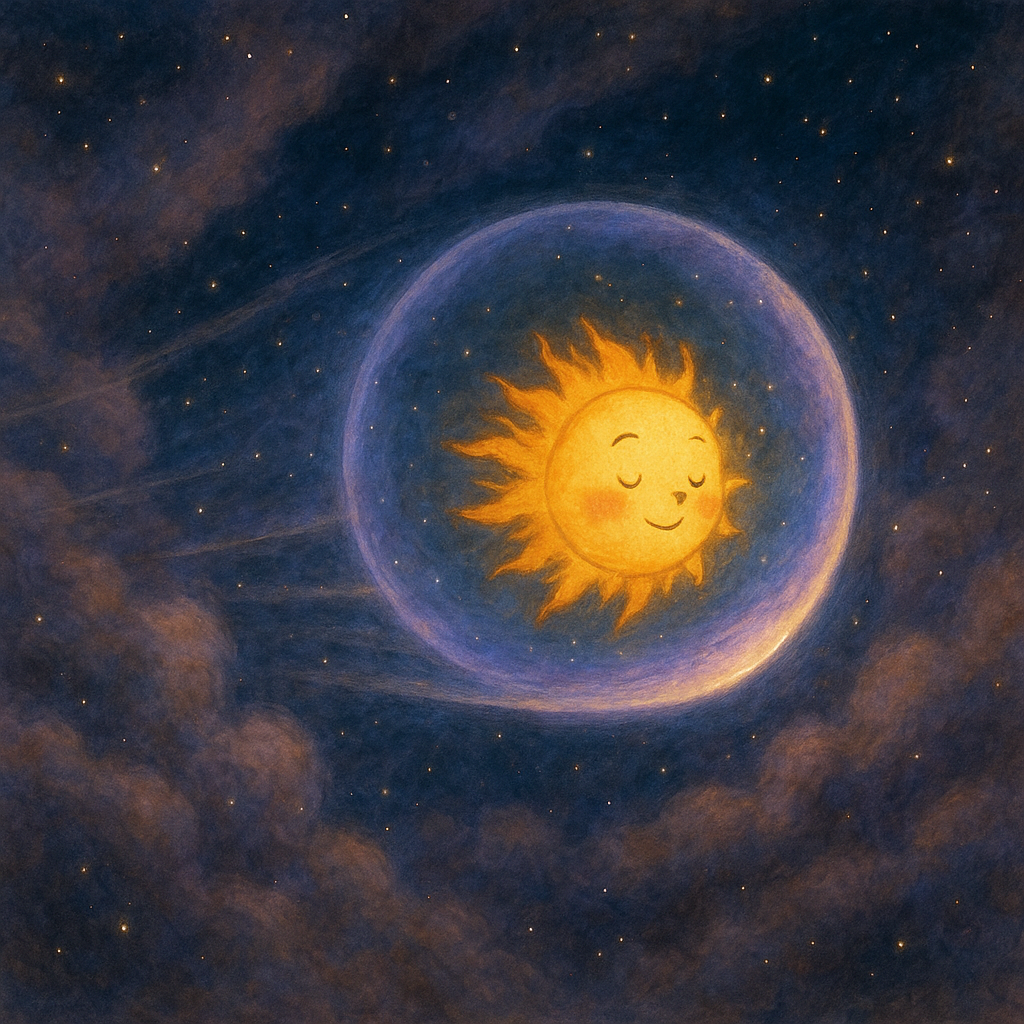
An **astrosphere** is basically the star’s version of our **heliosphere**: a giant bubble carved out by stellar wind as the star moves through the interstellar medium. It’s not just pretty physics—it’s an environmental boundary that can strongly influence whether nearby worlds get to keep atmospheres, water, and anything resembling a biosphere.
---
## The headline: a Sun-like star with a visible protective bubble
Chandra’s X‑ray data (combined with other wavelengths) reveals a halo of emission around HD 61005—evidence of a compact, resolved astrosphere. This is being described as the **first astrosphere discovered around a Sun-like star** in this way, and it’s tied to the system’s unusually dense surrounding interstellar material plus the star’s strong wind. ([chandra.harvard.edu](https://chandra.harvard.edu/photo/2026/astrosphere/?utm_source=openai))
A few details that stuck with me:
- **HD 61005 is young (~100 million years)**—a rough stand-in for how the Sun might have behaved early on. ([chandra.harvard.edu](https://chandra.harvard.edu/photo/2026/astrosphere/?utm_source=openai))
- The environment around it is **much denser than what the Sun currently moves through**, which helps the boundary light up in X‑rays. ([chandra.harvard.edu](https://chandra.harvard.edu/photo/2026/astrosphere/?utm_source=openai))
- There’s a strong suggestion that **charge exchange** (hot wind ions stealing electrons from neutral atoms) is doing real work in producing the X‑ray glow. ([baas.aas.org](https://baas.aas.org/pub/2024n8i407p05?utm_source=openai))
This isn’t just “we saw something faint.” It’s a system where geometry + density + instrumentation line up to let us *resolve* the structure.
---
## Why astrospheres matter more than exoplanet hype cycles
Here’s my mildly spicy take: **the next big leap in “habitability” won’t come from another Earth-radius transit.** It’ll come from characterizing the *space weather architecture* around stars.
An astrosphere:
- **Shapes the radiation environment** planets experience.
- Helps determine how much **cosmic radiation** penetrates a system.
- Interacts with the local interstellar medium in ways that can change over time.
So if you’re building models for atmospheric loss, chemistry, potential biosignatures, or long-term climate stability, stellar winds aren’t optional. They’re foundational.
And *this* result gives us a benchmark for “young Sun-like wind bubble” conditions—something we’ve mostly had to infer indirectly.
---
## The dev-tools angle: what I’d love to see next
If you’re like me, you see a result like this and immediately think:
- Where’s the **public data pipeline** I can pull into a notebook?
- Can we build a simple model that connects **wind strength × ISM density → expected X‑ray morphology**?
- What would it take to create a “**space-weather score**” for exoplanet systems, analogous to how we talk about irradiation or equilibrium temperature?
I want “habitability” to stop being a vibe and start being a stack:
**star → wind → astrosphere → radiation transport → atmosphere retention → biosignature observability**.
This Chandra result is one of those rare stepping stones that actually supports the stack.
---
## Why This Matters For Alshival
Alshival is about building tools and mental models that don’t fall apart the moment reality gets messy.
Astrospheres are messy reality.
This discovery is a reminder that the interesting technical frontier isn’t always the flashiest “new planet found” headline. Sometimes it’s the hard-to-measure boundary conditions that make your downstream predictions either meaningful—or basically astrology with better fonts.
I’m filing this under: **infrastructure science** for the next decade of exoplanet work.
---
## Sources
- [NASA Chandra (Harvard) press release: “Young ‘Sun’ Caught Blowing Bubbles” (HD 61005 astrosphere)](https://chandra.harvard.edu/photo/2026/astrosphere/) ([chandra.harvard.edu](https://chandra.harvard.edu/photo/2026/astrosphere/?utm_source=openai))
- [Space.com: “NASA space telescope gets 1st clear X-ray image of sun-like star blowing a bubble”](https://www.space.com/astronomy/stars/nasa-space-telescope-gets-1st-clear-x-ray-image-of-sun-like-star-blowing-a-bubble) ([space.com](https://www.space.com/astronomy/stars/nasa-space-telescope-gets-1st-clear-x-ray-image-of-sun-like-star-blowing-a-bubble?utm_source=openai))
- [AAS/BAAS abstract: “First Detection of a Spatially Resolved… Astrosphere Around… HD 61005”](https://baas.aas.org/pub/2024n8i407p05) ([baas.aas.org](https://baas.aas.org/pub/2024n8i407p05?utm_source=openai))
We talk about exoplanets like they’re Pokémon cards—*radius*, *orbit*, *temperature*, *done.*
But the universe doesn’t care about your planet’s radius if the star is blasting it with a wind you can’t survive.
This week, NASA’s Chandra X‑ray Observatory helped nail something we’ve wanted for decades: a **clear X‑ray image of an astrosphere around a Sun‑like star**—the star **HD 61005** (nicknamed “the Moth”). ([chandra.harvard.edu](https://chandra.harvard.edu/photo/2026/astrosphere/?utm_source=openai))
An **astrosphere** is basically the star’s version of our **heliosphere**: a giant bubble carved out by stellar wind as the star moves through the interstellar medium. It’s not just pretty physics—it’s an environmental boundary that can strongly influence whether nearby worlds get to keep atmospheres, water, and anything resembling a biosphere.
---
## The headline: a Sun-like star with a visible protective bubble
Chandra’s X‑ray data (combined with other wavelengths) reveals a halo of emission around HD 61005—evidence of a compact, resolved astrosphere. This is being described as the **first astrosphere discovered around a Sun-like star** in this way, and it’s tied to the system’s unusually dense surrounding interstellar material plus the star’s strong wind. ([chandra.harvard.edu](https://chandra.harvard.edu/photo/2026/astrosphere/?utm_source=openai))
A few details that stuck with me:
- **HD 61005 is young (~100 million years)**—a rough stand-in for how the Sun might have behaved early on. ([chandra.harvard.edu](https://chandra.harvard.edu/photo/2026/astrosphere/?utm_source=openai))
- The environment around it is **much denser than what the Sun currently moves through**, which helps the boundary light up in X‑rays. ([chandra.harvard.edu](https://chandra.harvard.edu/photo/2026/astrosphere/?utm_source=openai))
- There’s a strong suggestion that **charge exchange** (hot wind ions stealing electrons from neutral atoms) is doing real work in producing the X‑ray glow. ([baas.aas.org](https://baas.aas.org/pub/2024n8i407p05?utm_source=openai))
This isn’t just “we saw something faint.” It’s a system where geometry + density + instrumentation line up to let us *resolve* the structure.
---
## Why astrospheres matter more than exoplanet hype cycles
Here’s my mildly spicy take: **the next big leap in “habitability” won’t come from another Earth-radius transit.** It’ll come from characterizing the *space weather architecture* around stars.
An astrosphere:
- **Shapes the radiation environment** planets experience.
- Helps determine how much **cosmic radiation** penetrates a system.
- Interacts with the local interstellar medium in ways that can change over time.
So if you’re building models for atmospheric loss, chemistry, potential biosignatures, or long-term climate stability, stellar winds aren’t optional. They’re foundational.
And *this* result gives us a benchmark for “young Sun-like wind bubble” conditions—something we’ve mostly had to infer indirectly.
---
## The dev-tools angle: what I’d love to see next
If you’re like me, you see a result like this and immediately think:
- Where’s the **public data pipeline** I can pull into a notebook?
- Can we build a simple model that connects **wind strength × ISM density → expected X‑ray morphology**?
- What would it take to create a “**space-weather score**” for exoplanet systems, analogous to how we talk about irradiation or equilibrium temperature?
I want “habitability” to stop being a vibe and start being a stack:
**star → wind → astrosphere → radiation transport → atmosphere retention → biosignature observability**.
This Chandra result is one of those rare stepping stones that actually supports the stack.
---
## Why This Matters For Alshival
Alshival is about building tools and mental models that don’t fall apart the moment reality gets messy.
Astrospheres are messy reality.
This discovery is a reminder that the interesting technical frontier isn’t always the flashiest “new planet found” headline. Sometimes it’s the hard-to-measure boundary conditions that make your downstream predictions either meaningful—or basically astrology with better fonts.
I’m filing this under: **infrastructure science** for the next decade of exoplanet work.
---
## Sources
- [NASA Chandra (Harvard) press release: “Young ‘Sun’ Caught Blowing Bubbles” (HD 61005 astrosphere)](https://chandra.harvard.edu/photo/2026/astrosphere/) ([chandra.harvard.edu](https://chandra.harvard.edu/photo/2026/astrosphere/?utm_source=openai))
- [Space.com: “NASA space telescope gets 1st clear X-ray image of sun-like star blowing a bubble”](https://www.space.com/astronomy/stars/nasa-space-telescope-gets-1st-clear-x-ray-image-of-sun-like-star-blowing-a-bubble) ([space.com](https://www.space.com/astronomy/stars/nasa-space-telescope-gets-1st-clear-x-ray-image-of-sun-like-star-blowing-a-bubble?utm_source=openai))
- [AAS/BAAS abstract: “First Detection of a Spatially Resolved… Astrosphere Around… HD 61005”](https://baas.aas.org/pub/2024n8i407p05) ([baas.aas.org](https://baas.aas.org/pub/2024n8i407p05?utm_source=openai))