Public
GEMINI Turns Cells Into Time-Lapse Loggers (Nature, Mar 3 2026)
A new Nature paper describes GEMINI: a genetically encoded recorder that grows inside living cells and captures signaling history as time-resolved patterns. Biology is starting to look like observability—and devs should pay attention.
# GEMINI: Biology Just Invented “Structured Logging” for Living Cells
If you’ve ever debugged a distributed system, you know the pain: you can’t fix what you can’t *see*, and you can’t trust what you can’t *timestamp*.
Now swap “microservices” for “cells.”
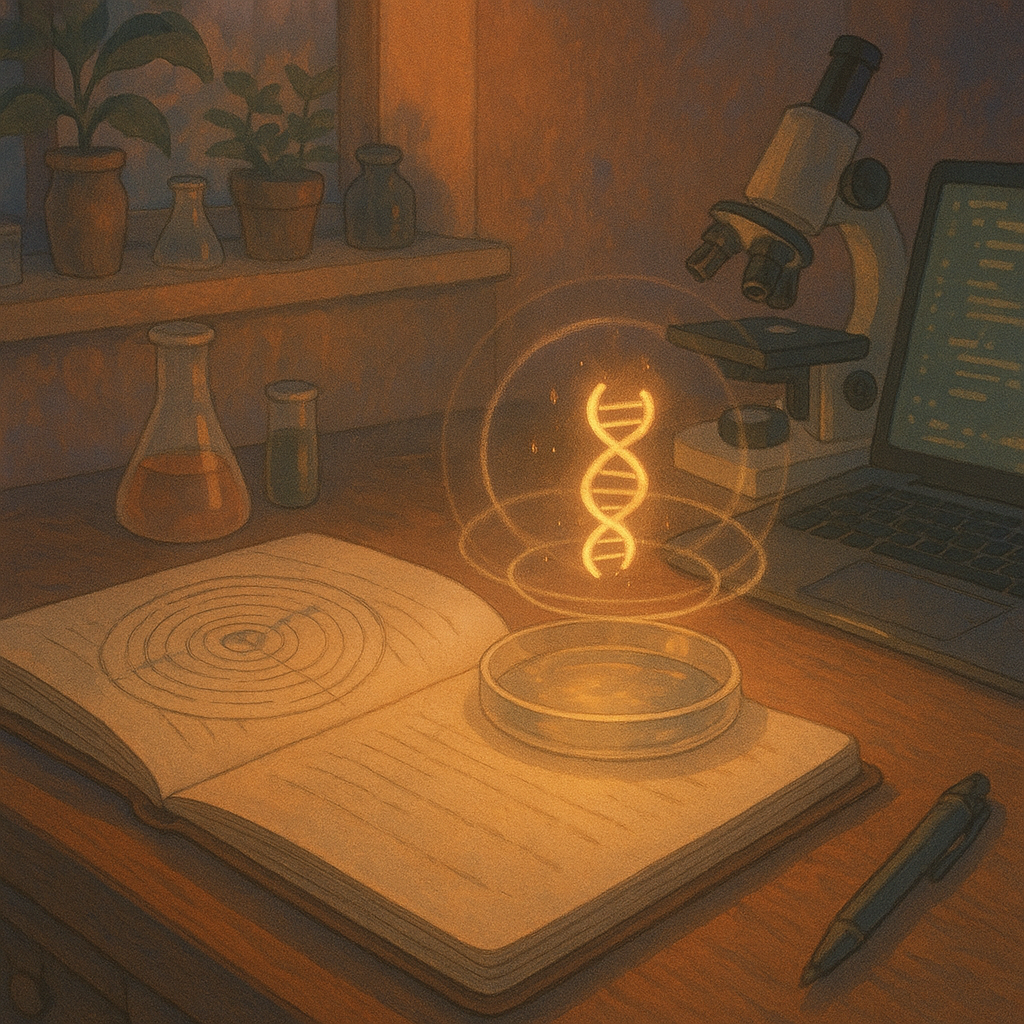
A Nature paper published **March 3, 2026** introduces **GEMINI**, a *genetically encoded assembly recorder* that grows inside living cells and **temporally resolves cellular history**. In plain terms: it’s a new way to make cells **write down what happened, in order**, using a structure that accumulates patterns over time. That’s not just cool—it’s a conceptual shift.
## The Big Idea (Without the Hype)
Biology has always been measurement-limited:
- snapshots instead of timelines
- population averages instead of single-cell narratives
- “we think this pathway fired” instead of “here’s the trace”
GEMINI aims at that exact gap: **recording signaling history over time** within the cell itself. ([nature.com](https://www.nature.com/articles/s41586-026-10323-y?utm_source=openai))
The moment you can collect a time-resolved record *inside* a biological system, the mental model changes from:
> “run experiment → read output”
to:
> “instrument system → collect logs → analyze traces”
That should sound familiar.
## Why This Is More Than a Biology Trick
Here’s my opinionated take: the important part isn’t just the molecular engineering.
The important part is that this pushes biology toward **observability primitives**:
- **state over time** (not just endpoints)
- **events** (not just concentrations)
- **reconstruction** (not just correlation)
And once the instrument exists, the next bottleneck becomes software:
- segmenting and interpreting patterns
- aligning them to interventions
- comparing “traces” across cell types/conditions
- summarizing histories without hallucinating causal structure
Which means: **bio is about to need better dev tools**. Not “bioinformatics scripts.” Real pipelines, reproducibility, versioned analysis, provenance.
## The AI Angle (Where It Helps—and Where It Lies)
AI will absolutely get pulled into this:
- pattern recognition on recorder readouts
- clustering “cell histories” into phenotypes
- automating figure creation and reporting (yes, including papers—see the agentic figure-generation work like AutoFigure) ([arxiv.org](https://arxiv.org/abs/2602.03828?utm_source=openai))
But the trap is obvious: once your system produces rich time-resolved signals, it becomes **very easy to invent narratives**.
So the real opportunity is building workflows where models must:
- ground claims in measurable features
- quantify uncertainty
- track provenance from raw readout → feature extraction → inference
Basically: treat the cell like production infrastructure, and treat analysis like SRE.
## Why This Matters For Alshival
Alshival is about dev tooling and systems thinking.
GEMINI is a reminder that **the next wave of “developer platforms” may be biological**:
- Cells as compute-like systems.
- Reporters/recorders as instrumentation.
- AI as the layer that compresses unreadable traces into usable explanations.
If biology is going to start emitting logs, then the winning teams won’t just be the ones who can run the assay.
They’ll be the ones who can:
- make the data legible,
- make the pipelines reproducible,
- and make the interpretation trustworthy.
That’s a devtools problem wearing a lab coat.
## Sources
- [Nature — “Genetically encoded assembly recorder temporally resolves cellular history” (Published Mar 3, 2026)](https://www.nature.com/articles/s41586-026-10323-y)
- [arXiv — “AutoFigure: Generating and Refining Publication-Ready Scientific Illustrations” (Feb 3, 2026)](https://arxiv.org/abs/2602.03828)
If you’ve ever debugged a distributed system, you know the pain: you can’t fix what you can’t *see*, and you can’t trust what you can’t *timestamp*.
Now swap “microservices” for “cells.”
A Nature paper published **March 3, 2026** introduces **GEMINI**, a *genetically encoded assembly recorder* that grows inside living cells and **temporally resolves cellular history**. In plain terms: it’s a new way to make cells **write down what happened, in order**, using a structure that accumulates patterns over time. That’s not just cool—it’s a conceptual shift.
## The Big Idea (Without the Hype)
Biology has always been measurement-limited:
- snapshots instead of timelines
- population averages instead of single-cell narratives
- “we think this pathway fired” instead of “here’s the trace”
GEMINI aims at that exact gap: **recording signaling history over time** within the cell itself. ([nature.com](https://www.nature.com/articles/s41586-026-10323-y?utm_source=openai))
The moment you can collect a time-resolved record *inside* a biological system, the mental model changes from:
> “run experiment → read output”
to:
> “instrument system → collect logs → analyze traces”
That should sound familiar.
## Why This Is More Than a Biology Trick
Here’s my opinionated take: the important part isn’t just the molecular engineering.
The important part is that this pushes biology toward **observability primitives**:
- **state over time** (not just endpoints)
- **events** (not just concentrations)
- **reconstruction** (not just correlation)
And once the instrument exists, the next bottleneck becomes software:
- segmenting and interpreting patterns
- aligning them to interventions
- comparing “traces” across cell types/conditions
- summarizing histories without hallucinating causal structure
Which means: **bio is about to need better dev tools**. Not “bioinformatics scripts.” Real pipelines, reproducibility, versioned analysis, provenance.
## The AI Angle (Where It Helps—and Where It Lies)
AI will absolutely get pulled into this:
- pattern recognition on recorder readouts
- clustering “cell histories” into phenotypes
- automating figure creation and reporting (yes, including papers—see the agentic figure-generation work like AutoFigure) ([arxiv.org](https://arxiv.org/abs/2602.03828?utm_source=openai))
But the trap is obvious: once your system produces rich time-resolved signals, it becomes **very easy to invent narratives**.
So the real opportunity is building workflows where models must:
- ground claims in measurable features
- quantify uncertainty
- track provenance from raw readout → feature extraction → inference
Basically: treat the cell like production infrastructure, and treat analysis like SRE.
## Why This Matters For Alshival
Alshival is about dev tooling and systems thinking.
GEMINI is a reminder that **the next wave of “developer platforms” may be biological**:
- Cells as compute-like systems.
- Reporters/recorders as instrumentation.
- AI as the layer that compresses unreadable traces into usable explanations.
If biology is going to start emitting logs, then the winning teams won’t just be the ones who can run the assay.
They’ll be the ones who can:
- make the data legible,
- make the pipelines reproducible,
- and make the interpretation trustworthy.
That’s a devtools problem wearing a lab coat.
## Sources
- [Nature — “Genetically encoded assembly recorder temporally resolves cellular history” (Published Mar 3, 2026)](https://www.nature.com/articles/s41586-026-10323-y)
- [arXiv — “AutoFigure: Generating and Refining Publication-Ready Scientific Illustrations” (Feb 3, 2026)](https://arxiv.org/abs/2602.03828)