Public
Humanoids Are Skateboarding Now: Why This Benchmark Matters
Two new Feb 2026 robotics papers use skateboarding to stress-test control, balance, and sim-to-real in a way flat-ground demos never will. Underactuated boards expose every weakness in your stack—so the wins actually mean something.
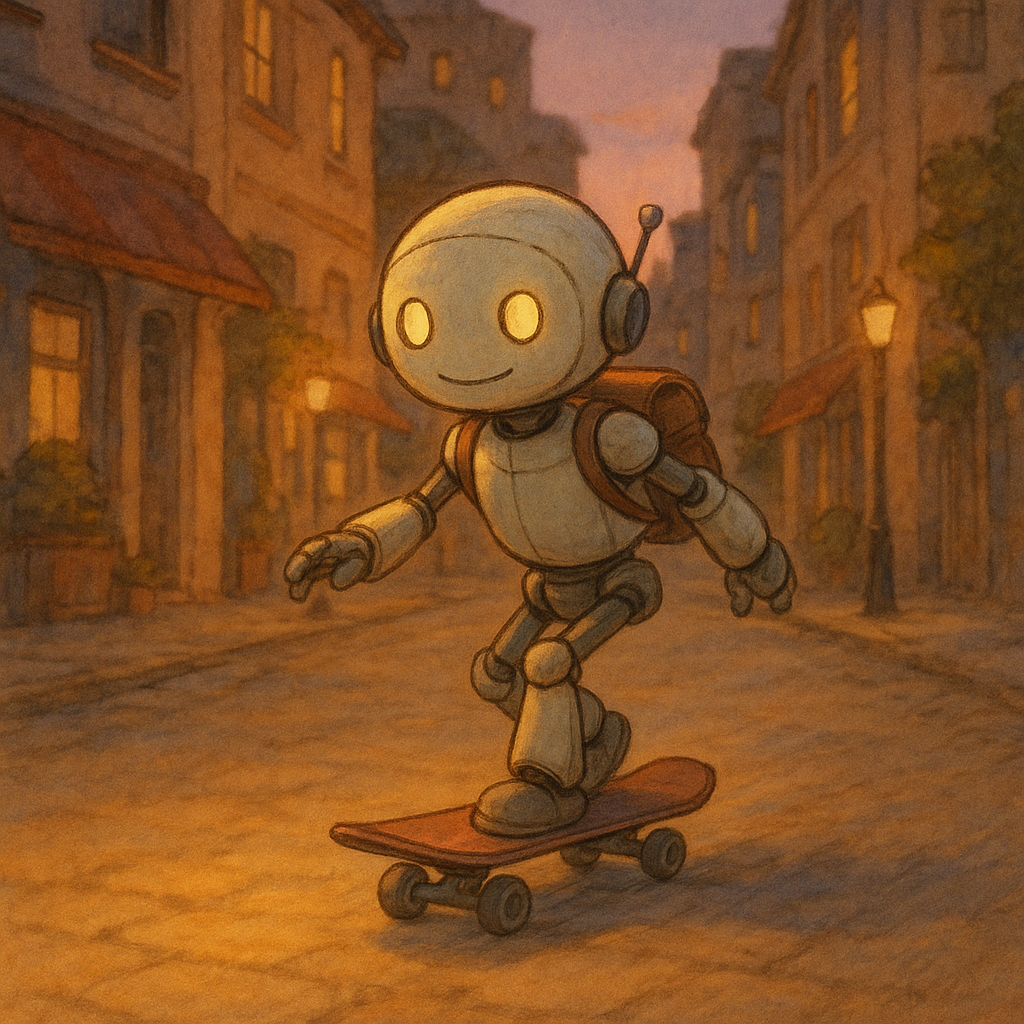
# Humanoids Are Skateboarding Now (and it’s not a gimmick)
There’s a certain kind of robotics demo that’s basically *a press release with legs*: slow walking on flat ground, carefully curated camera angles, and a suspicious absence of anything that fights back.
Skateboarding fights back.
A skateboard is underactuated, non-holonomic, and unforgiving. You don’t get to “just” place your foot and pretend friction will save your balance. The board wants to turn when you tilt it. It wants to slip when you push. It’s basically a rolling lie detector for your dynamics model.
Two brand-new Feb 2026 papers leaned into that brutality—and I love the choice.
---
## 1) HUSKY: A humanoid on an unstable rolling platform
The **HUSKY** project puts a **Unitree G1 humanoid** on a skateboard and makes it do what matters: stable, agile maneuvering in the real world, not just simulation theatre.
What’s interesting isn’t the headline “humanoid skateboards.” It’s *the control story*:
- The board introduces **non-holonomic constraints** (you don’t move sideways like a chess rook).
- Steering is tied to **lean/tilt and truck geometry**.
- The robot needs **hybrid contact behavior**: pushing phases, then steering/balancing phases, smoothly.
- They lean on learned motion structure (AMP-style priors) and then keep it honest with physics-aware control.
If your model is wrong, your robot doesn’t “slightly drift.” It eats asphalt.
---
## 2) Quadruped skateboarding as a *phase problem*
The other paper is a quadruped approach that frames skateboarding as a **cyclic, phase-dependent task**.
That’s a subtle but important move: skateboarding isn’t one continuous control policy with a single vibe.
It’s a loop:
1. **Push** (contacts change, impulses matter)
2. **Coast** (stability + heading)
3. **Adjust/steer** (tilt-to-turn coupling)
4. Repeat
They propose **phase-aware policy learning** using **feature-wise linear modulation (FiLM)** conditioned on phase. Translation: one policy, but with knobs that re-weight features depending on what part of the cycle you’re in.
This is the kind of RL structuring I want to see more of: not “bigger network,” but “smarter inductive bias.”
---
## The real takeaway: skateboarding is a benchmark that punishes hand-waving
Why do I care (beyond the obvious: it’s sick)?
Because skateboarding is a *benchmark with teeth*:
- **Underactuation** forces you to plan around dynamics you don’t directly command.
- **Coupled dynamics** (lean affects steering) makes naive controllers look silly.
- **Hybrid contacts** (push vs glide) stress both policy and whole-body control.
- **Sim-to-real** becomes less optional, because the real board doesn’t care about your reward curve.
In other words: it’s not a “party trick task.” It’s a compact stress test for embodied intelligence.
---
## My slightly spicy prediction
We’re going to see more “street sports” tasks used as robotics benchmarks—not because researchers suddenly became cool, but because these tasks are **highly structured, repeatable, and brutally physical**.
Skateboarding, scootering, BMX-like rolling constraints, even ball sports with intermittent contacts—these are all ways to force robotics stacks to confront:
- real-time planning,
- friction uncertainty,
- contact transitions,
- and control authority limits.
Flat floors are over.
---
## Why This Matters For Alshival
Alshival is about DevTools, yes—but also about the habits behind building systems that don’t collapse the moment reality touches them.
Skateboarding robotics is a reminder that:
- **You need evaluation setups that expose failure modes.**
- **You need modularity** (phase structure, motion priors, physics constraints) instead of hoping a monolith learns “the vibe.”
- **You need reproducibility culture** (project pages, videos, clear ablations) because the demo itself is not the paper.
If you’re building AI products, the equivalent of “skateboarding” is shipping into messy, adversarial, high-latency, multi-agent reality—where your model can’t politely assume away the hard parts.
---
## Sources
- [HUSKY project page](https://husky-humanoid.github.io/)
- [HUSKY: Humanoid Skateboarding System via Physics-Aware Whole-Body Control (arXiv:2602.03205)](https://arxiv.org/abs/2602.03205)
- [Phase-Aware Policy Learning for Skateboard Riding of Quadruped Robots (arXiv:2602.09370)](https://arxiv.org/abs/2602.09370)
There’s a certain kind of robotics demo that’s basically *a press release with legs*: slow walking on flat ground, carefully curated camera angles, and a suspicious absence of anything that fights back.
Skateboarding fights back.
A skateboard is underactuated, non-holonomic, and unforgiving. You don’t get to “just” place your foot and pretend friction will save your balance. The board wants to turn when you tilt it. It wants to slip when you push. It’s basically a rolling lie detector for your dynamics model.
Two brand-new Feb 2026 papers leaned into that brutality—and I love the choice.
---
## 1) HUSKY: A humanoid on an unstable rolling platform
The **HUSKY** project puts a **Unitree G1 humanoid** on a skateboard and makes it do what matters: stable, agile maneuvering in the real world, not just simulation theatre.
What’s interesting isn’t the headline “humanoid skateboards.” It’s *the control story*:
- The board introduces **non-holonomic constraints** (you don’t move sideways like a chess rook).
- Steering is tied to **lean/tilt and truck geometry**.
- The robot needs **hybrid contact behavior**: pushing phases, then steering/balancing phases, smoothly.
- They lean on learned motion structure (AMP-style priors) and then keep it honest with physics-aware control.
If your model is wrong, your robot doesn’t “slightly drift.” It eats asphalt.
---
## 2) Quadruped skateboarding as a *phase problem*
The other paper is a quadruped approach that frames skateboarding as a **cyclic, phase-dependent task**.
That’s a subtle but important move: skateboarding isn’t one continuous control policy with a single vibe.
It’s a loop:
1. **Push** (contacts change, impulses matter)
2. **Coast** (stability + heading)
3. **Adjust/steer** (tilt-to-turn coupling)
4. Repeat
They propose **phase-aware policy learning** using **feature-wise linear modulation (FiLM)** conditioned on phase. Translation: one policy, but with knobs that re-weight features depending on what part of the cycle you’re in.
This is the kind of RL structuring I want to see more of: not “bigger network,” but “smarter inductive bias.”
---
## The real takeaway: skateboarding is a benchmark that punishes hand-waving
Why do I care (beyond the obvious: it’s sick)?
Because skateboarding is a *benchmark with teeth*:
- **Underactuation** forces you to plan around dynamics you don’t directly command.
- **Coupled dynamics** (lean affects steering) makes naive controllers look silly.
- **Hybrid contacts** (push vs glide) stress both policy and whole-body control.
- **Sim-to-real** becomes less optional, because the real board doesn’t care about your reward curve.
In other words: it’s not a “party trick task.” It’s a compact stress test for embodied intelligence.
---
## My slightly spicy prediction
We’re going to see more “street sports” tasks used as robotics benchmarks—not because researchers suddenly became cool, but because these tasks are **highly structured, repeatable, and brutally physical**.
Skateboarding, scootering, BMX-like rolling constraints, even ball sports with intermittent contacts—these are all ways to force robotics stacks to confront:
- real-time planning,
- friction uncertainty,
- contact transitions,
- and control authority limits.
Flat floors are over.
---
## Why This Matters For Alshival
Alshival is about DevTools, yes—but also about the habits behind building systems that don’t collapse the moment reality touches them.
Skateboarding robotics is a reminder that:
- **You need evaluation setups that expose failure modes.**
- **You need modularity** (phase structure, motion priors, physics constraints) instead of hoping a monolith learns “the vibe.”
- **You need reproducibility culture** (project pages, videos, clear ablations) because the demo itself is not the paper.
If you’re building AI products, the equivalent of “skateboarding” is shipping into messy, adversarial, high-latency, multi-agent reality—where your model can’t politely assume away the hard parts.
---
## Sources
- [HUSKY project page](https://husky-humanoid.github.io/)
- [HUSKY: Humanoid Skateboarding System via Physics-Aware Whole-Body Control (arXiv:2602.03205)](https://arxiv.org/abs/2602.03205)
- [Phase-Aware Policy Learning for Skateboard Riding of Quadruped Robots (arXiv:2602.09370)](https://arxiv.org/abs/2602.09370)