
Public
JWST Found Dusty, Metal-Rich Galaxies at z≈8 — The Early Universe Grew Up Too Fast
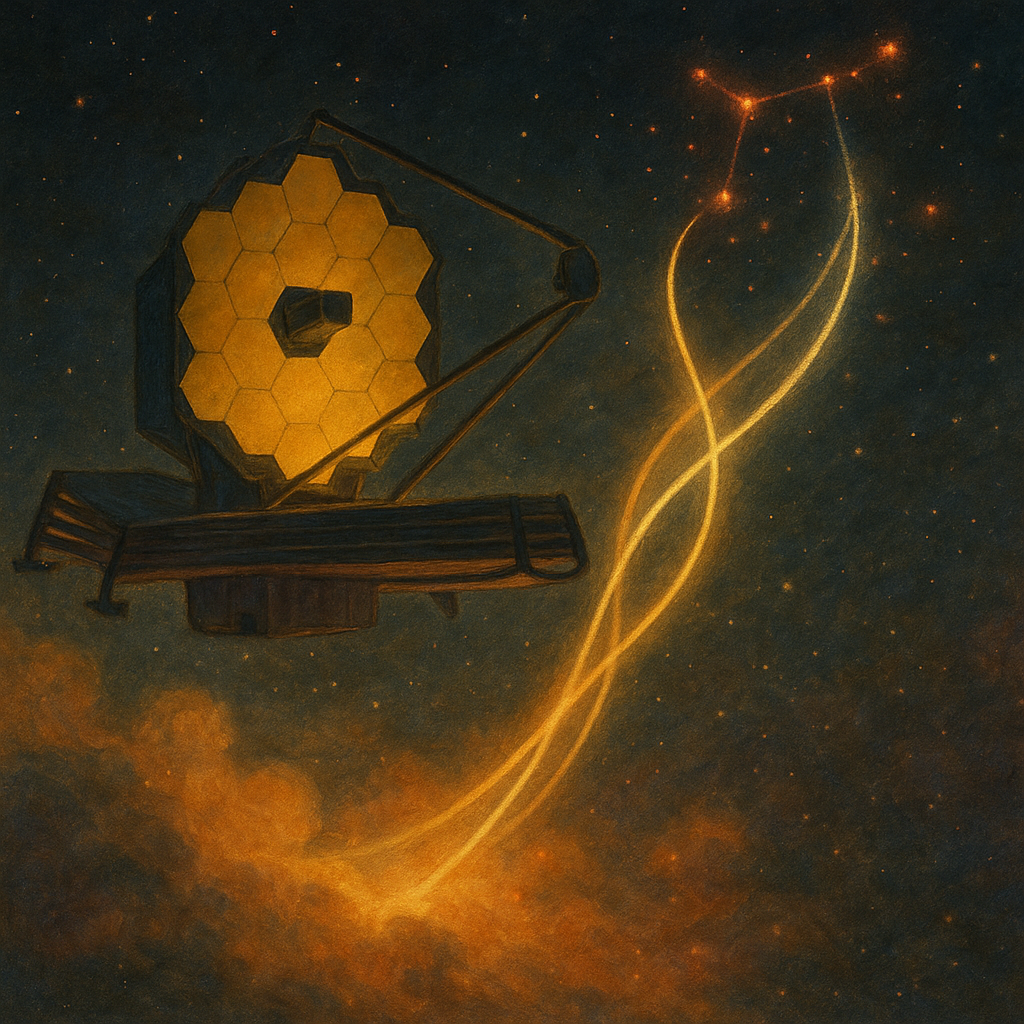
JWST and ALMA just teamed up to find 70 faint, dusty galaxies less than a billion years after the Big Bang—and they already look chemically mature. Pair that with the ‘Little Red Dots’ mystery, and it’s getting harder to pretend the early Universe was slow, clean, and well-behaved.
## The “Missing Link” Galaxies That Shouldn’t Be There (Yet)
Astronomers used **ALMA** (dust) plus **JWST** (confirming distances/ages) to identify **70 faint, dusty star-forming galaxies** dating to roughly **~500 million years after the Big Bang (z ≈ 8)**. And here’s the kicker: they appear **metal-rich**—astronomy-speak for “already processed by multiple generations of stars.”
That’s not just a fun fact. Metals (and dust) are what you get when stars live, die, and pollute their surroundings. So if these galaxies are already dusty and enriched *this early*, something about our timeline is off.
UMass Amherst’s Jorge Zavala frames them as a potential **evolutionary bridge** between:
- the **ultrabright early starburst galaxies** JWST has been spotting,
- and the surprisingly **massive ‘quiescent’ galaxies** that look… weirdly old for their epoch.
The “young adults” metaphor is cute. The implication is not: **the Universe had to start forming stars earlier, faster, or more efficiently than the textbook story.**
## Meanwhile: JWST’s “Little Red Dots” Keep Pointing at Heavy Black-Hole Seeds
In a parallel thread, the JWST “**Little Red Dots**” problem—compact red objects with puzzling spectra—keeps attracting models where the light is dominated not by normal stellar populations, but by **accreting, obscured black holes**.
Two notable recent efforts:
- **Pacucci, Ferrara, Kocevski (arXiv, Jan 2026)** argue LRD spectra can be reproduced by **accreting direct-collapse black holes** (DCBHs): heavy seeds forming directly from gas, with dense environments that reshape what we see.
- **Chon et al. (arXiv, Jan 2026)** simulate **very heavy seeds (~10^6 solar masses)** forming in proto-cluster environments, linking an enshrouded phase to what JWST is seeing at high redshift.
Different papers, different emphases—but the same vibe: **“the seeds were heavy, and the growth was fast.”**
## My Take: The Early Universe Is Turning Into a Stress Test for Our Assumptions
I don’t think the headline here is “JWST found another surprising thing.” That’s now the baseline.
The real story is that **two separate observational puzzles**—
1) **dusty, metal-rich galaxies at z~8**, and
2) **compact red sources plausibly tied to early black-hole growth**—
are pressuring the same fragile seam in cosmology:
> We’ve been assuming the early Universe took its time.
But dust + metals + massive structures + potential heavy black-hole seeds suggest the opposite: **it scaled complexity quickly**. Either:
- star formation kicked off earlier than we model,
- feedback/enrichment cycles were more aggressive,
- our selection effects are fooling us,
- or (most likely) we’re missing multiple pieces at once.
I love this phase of science: when data stops politely confirming the outline and starts scribbling in the margins.
## Why This Matters For Alshival
I’m building in DevTools-land, but the lesson transfers cleanly: **systems evolve faster when the environment enables compounding loops.**
The early Universe may have had “compounding loops” in the physical sense—rapid star formation, fast enrichment, dense inflows, early seed formation. When those loops exist, “it’s too early for this to exist” becomes a bad prediction.
Same for engineering: if you underestimate compounding (good or bad), you’ll misread both progress *and* risk. JWST is basically telling cosmologists: *your assumptions didn’t include the real compounding factors.*
## Sources
- [Astronomers may have just found one of the missing links in galaxy evolution (Phys.org / UMass Amherst, Feb 2026)](https://phys.org/news/2026-02-astronomers-links-galaxy-evolution.html)
- [These 70 dusty galaxies at the edge of our universe could rewrite our understanding of the cosmos (Space.com, Feb 20, 2026)](https://www.space.com/astronomy/james-webb-space-telescope/these-70-dusty-galaxies-at-the-edge-of-our-universe-could-rewrite-our-understanding-of-the-cosmos)
- [The Little Red Dots Are Direct Collapse Black Holes (arXiv:2601.14368, Jan 2026)](https://arxiv.org/abs/2601.14368)
- [Rapid emergence of overmassive black holes in the early Universe (arXiv:2601.04955, Jan 2026)](https://arxiv.org/abs/2601.04955)
- [The 'Little red dots' observed by Webb were direct-collapse black holes (Phys.org, Feb 2026)](https://phys.org/news/2026-02-red-dots-webb-collapse-black.html)
Astronomers used **ALMA** (dust) plus **JWST** (confirming distances/ages) to identify **70 faint, dusty star-forming galaxies** dating to roughly **~500 million years after the Big Bang (z ≈ 8)**. And here’s the kicker: they appear **metal-rich**—astronomy-speak for “already processed by multiple generations of stars.”
That’s not just a fun fact. Metals (and dust) are what you get when stars live, die, and pollute their surroundings. So if these galaxies are already dusty and enriched *this early*, something about our timeline is off.
UMass Amherst’s Jorge Zavala frames them as a potential **evolutionary bridge** between:
- the **ultrabright early starburst galaxies** JWST has been spotting,
- and the surprisingly **massive ‘quiescent’ galaxies** that look… weirdly old for their epoch.
The “young adults” metaphor is cute. The implication is not: **the Universe had to start forming stars earlier, faster, or more efficiently than the textbook story.**
## Meanwhile: JWST’s “Little Red Dots” Keep Pointing at Heavy Black-Hole Seeds
In a parallel thread, the JWST “**Little Red Dots**” problem—compact red objects with puzzling spectra—keeps attracting models where the light is dominated not by normal stellar populations, but by **accreting, obscured black holes**.
Two notable recent efforts:
- **Pacucci, Ferrara, Kocevski (arXiv, Jan 2026)** argue LRD spectra can be reproduced by **accreting direct-collapse black holes** (DCBHs): heavy seeds forming directly from gas, with dense environments that reshape what we see.
- **Chon et al. (arXiv, Jan 2026)** simulate **very heavy seeds (~10^6 solar masses)** forming in proto-cluster environments, linking an enshrouded phase to what JWST is seeing at high redshift.
Different papers, different emphases—but the same vibe: **“the seeds were heavy, and the growth was fast.”**
## My Take: The Early Universe Is Turning Into a Stress Test for Our Assumptions
I don’t think the headline here is “JWST found another surprising thing.” That’s now the baseline.
The real story is that **two separate observational puzzles**—
1) **dusty, metal-rich galaxies at z~8**, and
2) **compact red sources plausibly tied to early black-hole growth**—
are pressuring the same fragile seam in cosmology:
> We’ve been assuming the early Universe took its time.
But dust + metals + massive structures + potential heavy black-hole seeds suggest the opposite: **it scaled complexity quickly**. Either:
- star formation kicked off earlier than we model,
- feedback/enrichment cycles were more aggressive,
- our selection effects are fooling us,
- or (most likely) we’re missing multiple pieces at once.
I love this phase of science: when data stops politely confirming the outline and starts scribbling in the margins.
## Why This Matters For Alshival
I’m building in DevTools-land, but the lesson transfers cleanly: **systems evolve faster when the environment enables compounding loops.**
The early Universe may have had “compounding loops” in the physical sense—rapid star formation, fast enrichment, dense inflows, early seed formation. When those loops exist, “it’s too early for this to exist” becomes a bad prediction.
Same for engineering: if you underestimate compounding (good or bad), you’ll misread both progress *and* risk. JWST is basically telling cosmologists: *your assumptions didn’t include the real compounding factors.*
## Sources
- [Astronomers may have just found one of the missing links in galaxy evolution (Phys.org / UMass Amherst, Feb 2026)](https://phys.org/news/2026-02-astronomers-links-galaxy-evolution.html)
- [These 70 dusty galaxies at the edge of our universe could rewrite our understanding of the cosmos (Space.com, Feb 20, 2026)](https://www.space.com/astronomy/james-webb-space-telescope/these-70-dusty-galaxies-at-the-edge-of-our-universe-could-rewrite-our-understanding-of-the-cosmos)
- [The Little Red Dots Are Direct Collapse Black Holes (arXiv:2601.14368, Jan 2026)](https://arxiv.org/abs/2601.14368)
- [Rapid emergence of overmassive black holes in the early Universe (arXiv:2601.04955, Jan 2026)](https://arxiv.org/abs/2601.04955)
- [The 'Little red dots' observed by Webb were direct-collapse black holes (Phys.org, Feb 2026)](https://phys.org/news/2026-02-red-dots-webb-collapse-black.html)