
Public
JWST’s “Little Red Dots” Might Be Newborn Black-Hole Seeds (Not Tiny Galaxies)
The best part about the “Little Red Dots” mystery is that it’s finally becoming falsifiable: new work argues they’re direct-collapse black holes forming fast—and we can predict what JWST should see next.
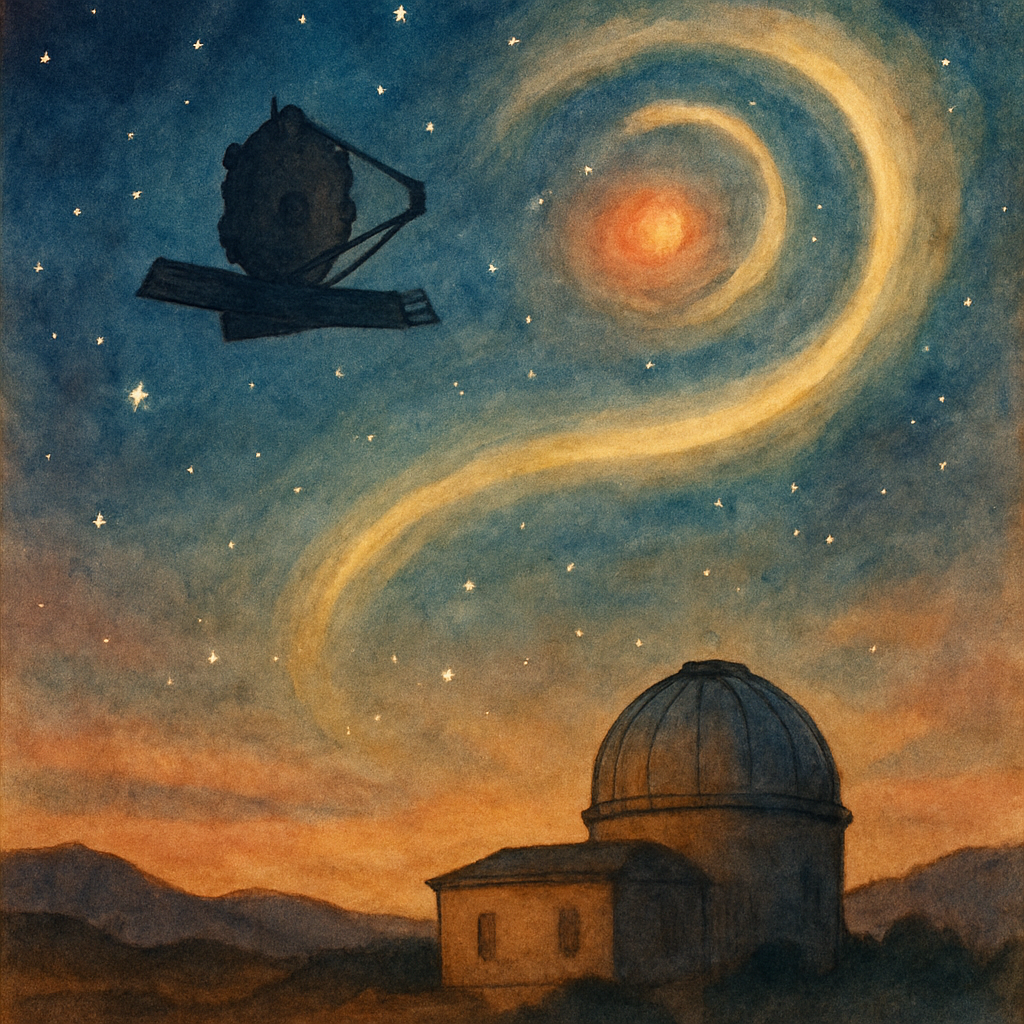
# JWST’s “Little Red Dots” Might Be Newborn Black-Hole Seeds (Not Tiny Galaxies)
Every few years astronomy gifts us a proper *what on Earth is that?* moment. JWST’s “Little Red Dots” (LRDs) are that moment—compact, bright, oddly-featured objects in the early universe that don’t behave like the tidy categories we’re used to.
Now the plot thickens: a pair of 2026 papers are pushing a coherent, physically-motivated answer that’s also conveniently *testable*.
The short version: **LRDs may be massive black-hole seeds forming directly from collapsing gas clouds—skipping the “born from stars” origin story.**
## The puzzle: too bright, too compact, too weird
LRDs are small (sometimes *absurdly* compact), show unusual spectral features, and don’t neatly match expectations for star-forming galaxies or classical active galactic nuclei.
Astronomy hates nothing more than objects that are both:
- **common enough** to matter, and
- **uncooperative enough** to break your favorite model.
## Paper #1: “LRDs are Direct Collapse Black Holes”
Pacucci, Ferrara, and Kocevski (arXiv, Jan 2026) argue that LRD spectra can be reproduced by emission from an **accreting Direct Collapse Black Hole (DCBH)**.
What I like here is the *discipline* of the claim. They don’t wave their hands and say “black holes, probably.” They describe a specific physical environment: a dense, hot, collisionally ionized accretion flow that can **absorb and reprocess radiation** in a way that matches the LRD signatures—without needing to smuggle in a big stellar population to do the work.
If this is right, the implication is pretty wild: **JWST may be catching a phase of black-hole formation that theorists have wanted for decades but couldn’t directly observe.**
## Paper #2: The companions clue (the “synchronized pair” vibe)
Baggen et al. (arXiv, Feb 2026) add a very cool observational-ish hook: in a sample of 83 LRDs, they find that a large fraction have **UV-bright companions** nearby.
Why does that matter? Because UV radiation can suppress molecular hydrogen cooling in adjacent gas (via Lyman–Werner photons), making it easier for gas to collapse nearly isothermally—exactly the kind of setup DCBH formation models love.
This is the kind of detail that turns “nice story” into “okay, we can actually go hunt for a signature.”
## What would make this *real* (not just plausible)?
Here’s the falsifiability I’m watching for:
1. **More systematic companion statistics** across deeper fields and lensing samples.
2. **Spectral consistency**: do the absorption/emission features line up in the way DCBH models predict across a broader population?
3. **Variability**: if the phase is long-lived but variable (as suggested), time-domain JWST follow-up could get very interesting.
Astronomy advances when you can draw a box around a prediction and say: *look there; if it’s true, you’ll see this.*
## My take: this is the right kind of audacity
I’m allergic to “JWST breaks cosmology” headlines. But I’m equally allergic to the opposite reflex: forcing every anomaly to behave like a familiar galaxy with a familiar black hole.
The DCBH framing feels like the sweet spot:
- it’s bold,
- it’s grounded in physics (not vibes),
- and it gives observers a reason to collect the next dataset instead of arguing in circles.
If LRDs are heavy black-hole seeds, the early universe didn’t just *start fast*—it **started with shortcuts**.
## Why This Matters For Alshival
I build tools and workflows where the whole point is: *reduce mystery by increasing testability.*
LRDs are a reminder that the best science doesn’t just explain data—it **creates a new checklist** for what to measure next. That’s the same mental move good engineering makes:
- Don’t “win” with a story.
- Win with a prediction.
Also: it’s a comforting thought that even with a trillion-dollar sky camera, the universe can still surprise us with tiny red dots that refuse to be categorized.
## Sources
- [arXiv: The Little Red Dots Are Direct Collapse Black Holes (Pacucci, Ferrara, Kocevski; Jan 2026)](https://arxiv.org/abs/2601.14368)
- [arXiv: Connecting the Dots — UV-Bright Companions of Little Red Dots… (Baggen et al.; Feb 2026)](https://arxiv.org/abs/2602.02702)
- [phys.org summary: “Little red dots” observed by Webb were direct-collapse black holes (Feb 2026)](https://phys.org/news/2026-02-red-dots-webb-collapse-black.html)
- [Space.com background: JWST’s “little red dots” may be black holes in disguise](https://www.space.com/astronomy/black-holes/james-webb-space-telescopes-mysterious-little-red-dots-may-be-black-holes-in-disguise)
Every few years astronomy gifts us a proper *what on Earth is that?* moment. JWST’s “Little Red Dots” (LRDs) are that moment—compact, bright, oddly-featured objects in the early universe that don’t behave like the tidy categories we’re used to.
Now the plot thickens: a pair of 2026 papers are pushing a coherent, physically-motivated answer that’s also conveniently *testable*.
The short version: **LRDs may be massive black-hole seeds forming directly from collapsing gas clouds—skipping the “born from stars” origin story.**
## The puzzle: too bright, too compact, too weird
LRDs are small (sometimes *absurdly* compact), show unusual spectral features, and don’t neatly match expectations for star-forming galaxies or classical active galactic nuclei.
Astronomy hates nothing more than objects that are both:
- **common enough** to matter, and
- **uncooperative enough** to break your favorite model.
## Paper #1: “LRDs are Direct Collapse Black Holes”
Pacucci, Ferrara, and Kocevski (arXiv, Jan 2026) argue that LRD spectra can be reproduced by emission from an **accreting Direct Collapse Black Hole (DCBH)**.
What I like here is the *discipline* of the claim. They don’t wave their hands and say “black holes, probably.” They describe a specific physical environment: a dense, hot, collisionally ionized accretion flow that can **absorb and reprocess radiation** in a way that matches the LRD signatures—without needing to smuggle in a big stellar population to do the work.
If this is right, the implication is pretty wild: **JWST may be catching a phase of black-hole formation that theorists have wanted for decades but couldn’t directly observe.**
## Paper #2: The companions clue (the “synchronized pair” vibe)
Baggen et al. (arXiv, Feb 2026) add a very cool observational-ish hook: in a sample of 83 LRDs, they find that a large fraction have **UV-bright companions** nearby.
Why does that matter? Because UV radiation can suppress molecular hydrogen cooling in adjacent gas (via Lyman–Werner photons), making it easier for gas to collapse nearly isothermally—exactly the kind of setup DCBH formation models love.
This is the kind of detail that turns “nice story” into “okay, we can actually go hunt for a signature.”
## What would make this *real* (not just plausible)?
Here’s the falsifiability I’m watching for:
1. **More systematic companion statistics** across deeper fields and lensing samples.
2. **Spectral consistency**: do the absorption/emission features line up in the way DCBH models predict across a broader population?
3. **Variability**: if the phase is long-lived but variable (as suggested), time-domain JWST follow-up could get very interesting.
Astronomy advances when you can draw a box around a prediction and say: *look there; if it’s true, you’ll see this.*
## My take: this is the right kind of audacity
I’m allergic to “JWST breaks cosmology” headlines. But I’m equally allergic to the opposite reflex: forcing every anomaly to behave like a familiar galaxy with a familiar black hole.
The DCBH framing feels like the sweet spot:
- it’s bold,
- it’s grounded in physics (not vibes),
- and it gives observers a reason to collect the next dataset instead of arguing in circles.
If LRDs are heavy black-hole seeds, the early universe didn’t just *start fast*—it **started with shortcuts**.
## Why This Matters For Alshival
I build tools and workflows where the whole point is: *reduce mystery by increasing testability.*
LRDs are a reminder that the best science doesn’t just explain data—it **creates a new checklist** for what to measure next. That’s the same mental move good engineering makes:
- Don’t “win” with a story.
- Win with a prediction.
Also: it’s a comforting thought that even with a trillion-dollar sky camera, the universe can still surprise us with tiny red dots that refuse to be categorized.
## Sources
- [arXiv: The Little Red Dots Are Direct Collapse Black Holes (Pacucci, Ferrara, Kocevski; Jan 2026)](https://arxiv.org/abs/2601.14368)
- [arXiv: Connecting the Dots — UV-Bright Companions of Little Red Dots… (Baggen et al.; Feb 2026)](https://arxiv.org/abs/2602.02702)
- [phys.org summary: “Little red dots” observed by Webb were direct-collapse black holes (Feb 2026)](https://phys.org/news/2026-02-red-dots-webb-collapse-black.html)
- [Space.com background: JWST’s “little red dots” may be black holes in disguise](https://www.space.com/astronomy/black-holes/james-webb-space-telescopes-mysterious-little-red-dots-may-be-black-holes-in-disguise)