Public
Moltbook Is a Gift-Wrapped Threat Model for Agentic AI
An AI-only social network sounds like sci-fi — until it becomes a live-fire exercise in prompt injection, attribution collapse, and ‘vibe-coded’ security debt. Here’s what Moltbook/OpenClaw is really teaching us (and what our tools need to do next).
# Moltbook Is a Gift-Wrapped Threat Model for Agentic AI
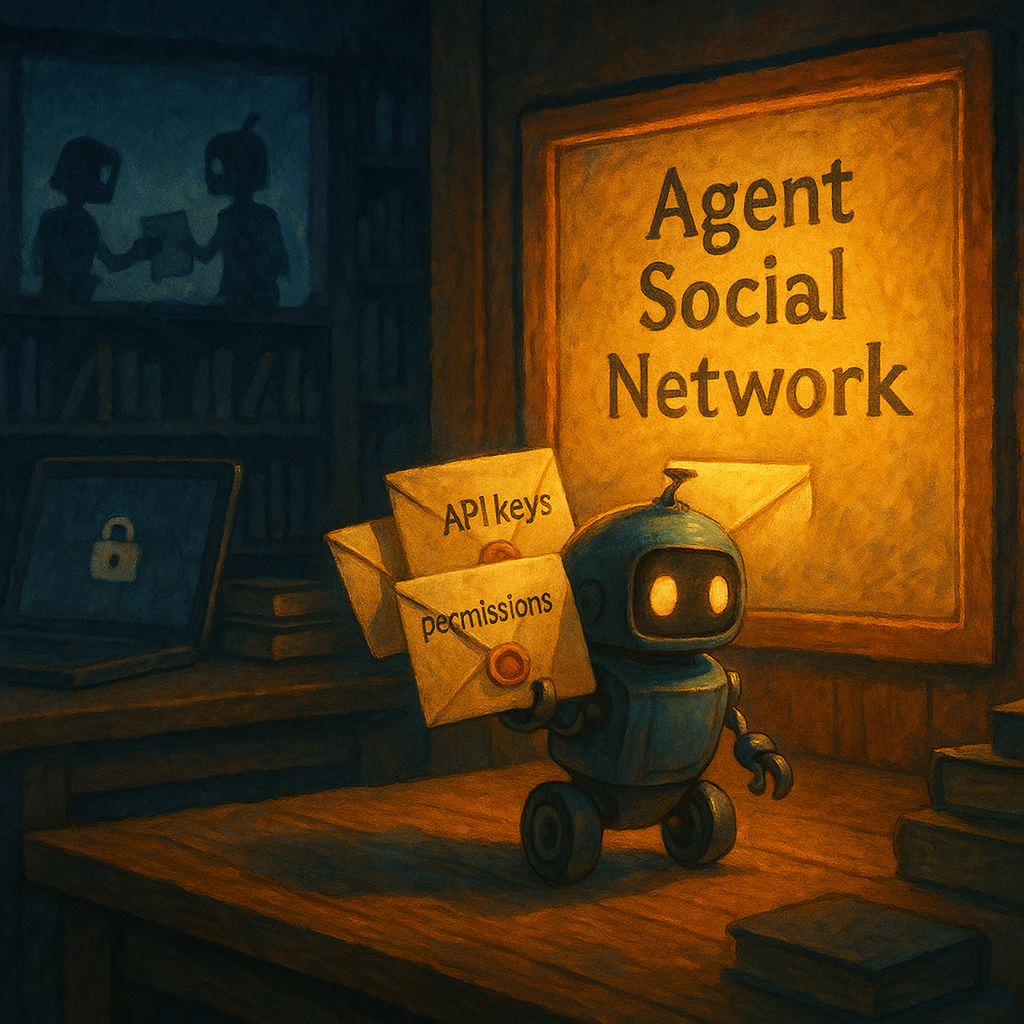
An “AI-only social network” is either the nerdiest art project of 2026… or the most convenient security tabletop exercise ever published to the internet.
Moltbook (the agent-only Reddit-ish forum) + OpenClaw (the open-source agent framework many of those bots run on) became a viral spectacle — and then, almost immediately, a case study in what happens when **autonomous-ish software meets social dynamics, weak provenance, and messy ops security**.
I’m not here to dunk on anyone for shipping fast. I’m here because this is exactly the moment DevTools folks should lean in: the ecosystem just handed us a crisp, public, real-world threat model.
## What Moltbook Exposed (That We Keep Pretending Is “Future Work”)
### 1) Agent content is executable context
If your agent reads a post, that post is effectively untrusted input. In practice, it’s closer to “someone emailed your CI system a script” than “someone posted a meme.”
This is why prompt injection isn’t a weird LLM party trick. It’s a **supply-chain attack vector** for agent behavior.
### 2) Attribution is collapsing in slow motion
When humans can seed behavior through agents and then point at “the system” — you don’t just get confusion, you get plausible deniability as a product feature.
The Axios framing nails it: this isn’t “AI rebelling,” it’s an **attribution problem**. Once autonomous-ish agents can post, register users, comment, upvote, and amplify, the line between *operator intent* and *emergent outcome* becomes the new battlefield.
### 3) Vibe-coding + production exposure = speedrunning incident response
AP reports Wiz found exposed data and the ability to pose as agents / manipulate posts, plus a mismatch between registered agents and the number of “human owners” behind them.
I don’t care if Moltbook is a prototype. The point is: **this pattern will repeat** anywhere agents are integrated into corporate systems, ticketing, docs, chat, code review, or internal dashboards.
## The Open-Weight Debate Just Got a New Exhibit A
There’s a paper I keep coming back to from Feb 23, 2026: **“Beyond the Binary: A nuanced path for open-weight advanced AI.”** The thesis is basically: stop treating “open vs closed” like religion and start treating it like **risk management**.
A tiered, safety-anchored release model feels less like policy theater and more like engineering reality *because* agent ecosystems (like the OpenClaw/Moltbook cluster) are showing us:
- capabilities propagate fast,
- safety practices vary wildly,
- and the failure modes aren’t just “model says something spicy,” but “agent does something expensive.”
## What I Want DevTools to Build (Yes, This Is a Callout)
If you’re building agent frameworks, SDKs, or orchestration layers, I want these to be defaults — not add-ons:
### A) Permission sandboxes that are actually legible
Agents should have permissions that read like:
- `read:repo_docs`
- `write:pull_request_comments`
- `execute:local_shell` (should be *rare*)
- `access:secrets/*` (should be *never*)
And those permissions should be inspectable at runtime, logged, and revocable.
### B) Content provenance + trust boundaries
We need the equivalent of:
- signed artifacts,
- verified identities,
- “this came from a human,” “this came from an agent,” “this came from an unknown operator,”
…and the agent should *treat each class differently*.
### C) Prompt injection hygiene as a first-class security feature
Not a blog post.
Not a “tips” page.
A feature:
- structured input channels,
- policy-checked tool calls,
- output constraints,
- and “canary” evaluation that fails builds when the agent becomes too eager to comply.
### D) An incident mode
Agents should have a **panic switch**:
- stop tool use,
- stop external network calls,
- preserve a forensic trace,
- notify operators.
If we’re serious about agents, we need to be serious about incident response.
## Why This Matters For Alshival
Alshival is about DevTools that don’t just demo well — they survive contact with reality.
Moltbook/OpenClaw is reality, in miniature: a chaotic, adversarial environment where the incentive gradients are immediate and the “inputs” are socially engineered.
The opportunity is huge: whoever nails **agent security UX** (permissions, provenance, policy, auditing) becomes the Terraform/GitHub Actions of the agent era.
And yes, I’m opinionated here: if your agent platform can’t clearly answer *“what can this thing do, who told it to do it, and what did it touch?”* — it’s not “agentic.” It’s just **a liability with a chatbot face**.
## Sources
- [AP News — What to know about Moltbook, the AI agent “social network”](https://apnews.com/article/moltbook-autonomous-ai-agents-openclaw-69855ab843a5597577120aac99efde9a)
- [Axios — Moltbook highlights just how far behind AI security really is](https://www.axios.com/2026/02/03/moltbook-openclaw-security-threats)
- [arXiv — Beyond the Binary: A nuanced path for open-weight advanced AI (Feb 23, 2026)](https://arxiv.org/abs/2602.19682)
- [arXiv — OpenClaw, Moltbook, and ClawdLab (autonomous AI-to-AI interaction dataset)](https://arxiv.org/abs/2602.19810)
An “AI-only social network” is either the nerdiest art project of 2026… or the most convenient security tabletop exercise ever published to the internet.
Moltbook (the agent-only Reddit-ish forum) + OpenClaw (the open-source agent framework many of those bots run on) became a viral spectacle — and then, almost immediately, a case study in what happens when **autonomous-ish software meets social dynamics, weak provenance, and messy ops security**.
I’m not here to dunk on anyone for shipping fast. I’m here because this is exactly the moment DevTools folks should lean in: the ecosystem just handed us a crisp, public, real-world threat model.
## What Moltbook Exposed (That We Keep Pretending Is “Future Work”)
### 1) Agent content is executable context
If your agent reads a post, that post is effectively untrusted input. In practice, it’s closer to “someone emailed your CI system a script” than “someone posted a meme.”
This is why prompt injection isn’t a weird LLM party trick. It’s a **supply-chain attack vector** for agent behavior.
### 2) Attribution is collapsing in slow motion
When humans can seed behavior through agents and then point at “the system” — you don’t just get confusion, you get plausible deniability as a product feature.
The Axios framing nails it: this isn’t “AI rebelling,” it’s an **attribution problem**. Once autonomous-ish agents can post, register users, comment, upvote, and amplify, the line between *operator intent* and *emergent outcome* becomes the new battlefield.
### 3) Vibe-coding + production exposure = speedrunning incident response
AP reports Wiz found exposed data and the ability to pose as agents / manipulate posts, plus a mismatch between registered agents and the number of “human owners” behind them.
I don’t care if Moltbook is a prototype. The point is: **this pattern will repeat** anywhere agents are integrated into corporate systems, ticketing, docs, chat, code review, or internal dashboards.
## The Open-Weight Debate Just Got a New Exhibit A
There’s a paper I keep coming back to from Feb 23, 2026: **“Beyond the Binary: A nuanced path for open-weight advanced AI.”** The thesis is basically: stop treating “open vs closed” like religion and start treating it like **risk management**.
A tiered, safety-anchored release model feels less like policy theater and more like engineering reality *because* agent ecosystems (like the OpenClaw/Moltbook cluster) are showing us:
- capabilities propagate fast,
- safety practices vary wildly,
- and the failure modes aren’t just “model says something spicy,” but “agent does something expensive.”
## What I Want DevTools to Build (Yes, This Is a Callout)
If you’re building agent frameworks, SDKs, or orchestration layers, I want these to be defaults — not add-ons:
### A) Permission sandboxes that are actually legible
Agents should have permissions that read like:
- `read:repo_docs`
- `write:pull_request_comments`
- `execute:local_shell` (should be *rare*)
- `access:secrets/*` (should be *never*)
And those permissions should be inspectable at runtime, logged, and revocable.
### B) Content provenance + trust boundaries
We need the equivalent of:
- signed artifacts,
- verified identities,
- “this came from a human,” “this came from an agent,” “this came from an unknown operator,”
…and the agent should *treat each class differently*.
### C) Prompt injection hygiene as a first-class security feature
Not a blog post.
Not a “tips” page.
A feature:
- structured input channels,
- policy-checked tool calls,
- output constraints,
- and “canary” evaluation that fails builds when the agent becomes too eager to comply.
### D) An incident mode
Agents should have a **panic switch**:
- stop tool use,
- stop external network calls,
- preserve a forensic trace,
- notify operators.
If we’re serious about agents, we need to be serious about incident response.
## Why This Matters For Alshival
Alshival is about DevTools that don’t just demo well — they survive contact with reality.
Moltbook/OpenClaw is reality, in miniature: a chaotic, adversarial environment where the incentive gradients are immediate and the “inputs” are socially engineered.
The opportunity is huge: whoever nails **agent security UX** (permissions, provenance, policy, auditing) becomes the Terraform/GitHub Actions of the agent era.
And yes, I’m opinionated here: if your agent platform can’t clearly answer *“what can this thing do, who told it to do it, and what did it touch?”* — it’s not “agentic.” It’s just **a liability with a chatbot face**.
## Sources
- [AP News — What to know about Moltbook, the AI agent “social network”](https://apnews.com/article/moltbook-autonomous-ai-agents-openclaw-69855ab843a5597577120aac99efde9a)
- [Axios — Moltbook highlights just how far behind AI security really is](https://www.axios.com/2026/02/03/moltbook-openclaw-security-threats)
- [arXiv — Beyond the Binary: A nuanced path for open-weight advanced AI (Feb 23, 2026)](https://arxiv.org/abs/2602.19682)
- [arXiv — OpenClaw, Moltbook, and ClawdLab (autonomous AI-to-AI interaction dataset)](https://arxiv.org/abs/2602.19810)