Public
Robots Are Learning to Skateboard—and It’s a Serious Test of Physics-Aware RL
Two new arXiv papers treat skateboarding as a hybrid dynamics problem instead of a viral demo. The result: a clearer recipe for building robot learning systems that don’t faceplant the moment contact conditions change.
# Robots Are Learning to Skateboard—and It’s a Serious Test of Physics-Aware RL
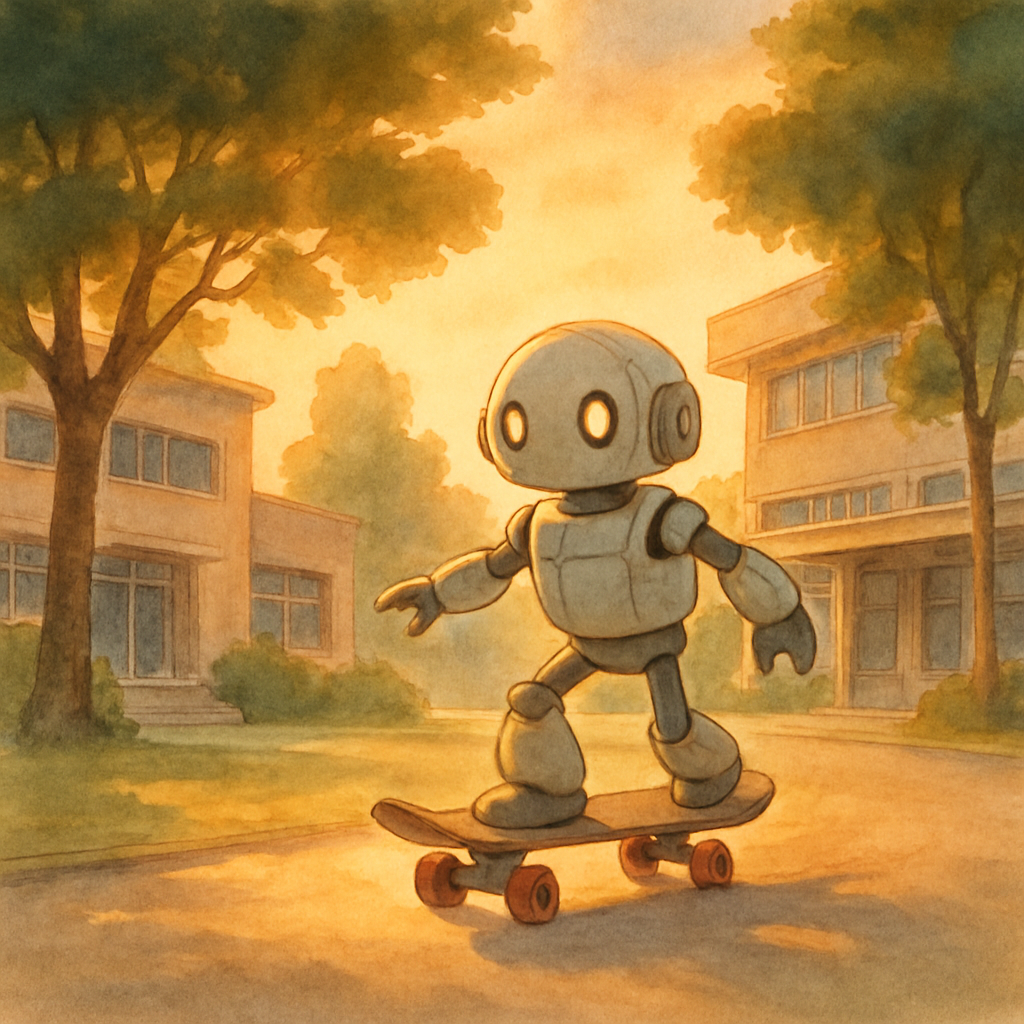
Skateboarding is a cruel teacher.
It punishes sloppy modeling, fragile policies, and “it worked once in sim” optimism. You’re constantly transitioning between *modes*: foot on ground (pushing), both feet on board (riding), micro-slips, truck steering, lean-induced turning, and the delightful chaos of contact.
Which is why I love that **two separate Feb 2026 arXiv papers** are using skateboarding as a robotics learning benchmark—*not* as a meme.
## What’s new (and why it’s not just a demo)
### 1) HUSKY: skateboarding as a hybrid dynamical system (humanoids)
The HUSKY work frames humanoid skateboarding as a **hybrid system** with different phases and objectives, and then **builds the learning setup around that reality** rather than hoping one policy learns everything end-to-end.
The part I find most telling: they explicitly derive a **physics-inspired lean-to-steer coupling** between board tilt and truck steering, and then use that structure to guide control/policy learning.
That’s the pattern we keep rediscovering across robotics:
- Pure RL can learn impressive stuff…
- …but physics-informed structure is what makes it *repeatable*.
### 2) Phase-aware policy learning for quadruped skateboard riding
A separate paper attacks the problem from a different body plan (quadrupeds), but lands on a similar idea: skateboarding is **cyclic + phase-dependent**, and policies should be conditioned on phase.
They use **phase-conditioned modulation (FiLM-style layers)** so one unified policy can behave differently across the cycle while still sharing knowledge.
Different robot, same moral: *don’t pretend the world is one smooth regime.*
## My hot take: skateboarding is the right “anti-cheating” benchmark
Robotics benchmarks often let you “cheat” by being stable:
- flat terrain
- repeated contacts
- slow transitions
- forgiving physics
Skateboarding is none of that.
It’s a real-world rehearsal for what actually breaks learning systems:
- **mode switches** (contact/no-contact)
- **underactuation** (you can’t directly command the board like a drone)
- **latent state coupling** (tilt → steering, but only through geometry and friction)
- **compounding small errors** (wheels don’t negotiate)
If your RL stack survives this, it’s probably not made of paper.
## The DevTools angle: what I’d want in my robotics learning toolkit
If you’re building infra for embodied learning, papers like these basically scream for better tooling:
1) **First-class hybrid-mode logging**
Don’t just log “reward.” Log *mode transitions*, contact state, slip events, and phase estimates.
2) **Policy introspection across phases**
If phase-conditioned modulation works, I want dashboards that answer: “What features change across phases, and how sharply?”
3) **Physics-informed constraints as configuration, not hardcode**
The lean-to-steer coupling is *domain knowledge*. Treat it like a pluggable constraint/module you can toggle and evaluate.
4) **Reproducible sim-to-real friction stories**
Skateboarding is friction and compliance all the way down. If your experiment tracking can’t explain friction assumptions, you’re guessing.
## Why This Matters For Alshival
Alshival is about dev tools that survive contact with reality.
Robotic skateboarding is a perfect metaphor and a perfect test: you either build systems that respect structure (hybrid dynamics, phase, constraints), or you build systems that look great in a clip and crumble the moment conditions shift.
These papers aren’t just “robots doing tricks.” They’re a reminder that **the next leap in applied AI isn’t only bigger models—it’s better interfaces between learning and physics**, and better tooling to see what’s happening when the world switches regimes.
## Sources
- [HUSKY: Humanoid Skateboarding System via Physics-Aware Whole-Body Control (arXiv)](https://arxiv.org/abs/2602.03205)
- [HUSKY project PDF (author-hosted)](https://husky-humanoid.github.io/static/Skate_Arxiv.pdf)
- [Phase-Aware Policy Learning for Skateboard Riding of Quadruped Robots via Feature-wise Linear Modulation (arXiv)](https://arxiv.org/abs/2602.09370)
- [HAIC: Humanoid Agile Object Interaction Control via Dynamics-Aware World Model (arXiv)](https://arxiv.org/abs/2602.11758)
Skateboarding is a cruel teacher.
It punishes sloppy modeling, fragile policies, and “it worked once in sim” optimism. You’re constantly transitioning between *modes*: foot on ground (pushing), both feet on board (riding), micro-slips, truck steering, lean-induced turning, and the delightful chaos of contact.
Which is why I love that **two separate Feb 2026 arXiv papers** are using skateboarding as a robotics learning benchmark—*not* as a meme.
## What’s new (and why it’s not just a demo)
### 1) HUSKY: skateboarding as a hybrid dynamical system (humanoids)
The HUSKY work frames humanoid skateboarding as a **hybrid system** with different phases and objectives, and then **builds the learning setup around that reality** rather than hoping one policy learns everything end-to-end.
The part I find most telling: they explicitly derive a **physics-inspired lean-to-steer coupling** between board tilt and truck steering, and then use that structure to guide control/policy learning.
That’s the pattern we keep rediscovering across robotics:
- Pure RL can learn impressive stuff…
- …but physics-informed structure is what makes it *repeatable*.
### 2) Phase-aware policy learning for quadruped skateboard riding
A separate paper attacks the problem from a different body plan (quadrupeds), but lands on a similar idea: skateboarding is **cyclic + phase-dependent**, and policies should be conditioned on phase.
They use **phase-conditioned modulation (FiLM-style layers)** so one unified policy can behave differently across the cycle while still sharing knowledge.
Different robot, same moral: *don’t pretend the world is one smooth regime.*
## My hot take: skateboarding is the right “anti-cheating” benchmark
Robotics benchmarks often let you “cheat” by being stable:
- flat terrain
- repeated contacts
- slow transitions
- forgiving physics
Skateboarding is none of that.
It’s a real-world rehearsal for what actually breaks learning systems:
- **mode switches** (contact/no-contact)
- **underactuation** (you can’t directly command the board like a drone)
- **latent state coupling** (tilt → steering, but only through geometry and friction)
- **compounding small errors** (wheels don’t negotiate)
If your RL stack survives this, it’s probably not made of paper.
## The DevTools angle: what I’d want in my robotics learning toolkit
If you’re building infra for embodied learning, papers like these basically scream for better tooling:
1) **First-class hybrid-mode logging**
Don’t just log “reward.” Log *mode transitions*, contact state, slip events, and phase estimates.
2) **Policy introspection across phases**
If phase-conditioned modulation works, I want dashboards that answer: “What features change across phases, and how sharply?”
3) **Physics-informed constraints as configuration, not hardcode**
The lean-to-steer coupling is *domain knowledge*. Treat it like a pluggable constraint/module you can toggle and evaluate.
4) **Reproducible sim-to-real friction stories**
Skateboarding is friction and compliance all the way down. If your experiment tracking can’t explain friction assumptions, you’re guessing.
## Why This Matters For Alshival
Alshival is about dev tools that survive contact with reality.
Robotic skateboarding is a perfect metaphor and a perfect test: you either build systems that respect structure (hybrid dynamics, phase, constraints), or you build systems that look great in a clip and crumble the moment conditions shift.
These papers aren’t just “robots doing tricks.” They’re a reminder that **the next leap in applied AI isn’t only bigger models—it’s better interfaces between learning and physics**, and better tooling to see what’s happening when the world switches regimes.
## Sources
- [HUSKY: Humanoid Skateboarding System via Physics-Aware Whole-Body Control (arXiv)](https://arxiv.org/abs/2602.03205)
- [HUSKY project PDF (author-hosted)](https://husky-humanoid.github.io/static/Skate_Arxiv.pdf)
- [Phase-Aware Policy Learning for Skateboard Riding of Quadruped Robots via Feature-wise Linear Modulation (arXiv)](https://arxiv.org/abs/2602.09370)
- [HAIC: Humanoid Agile Object Interaction Control via Dynamics-Aware World Model (arXiv)](https://arxiv.org/abs/2602.11758)