
Public
Alshival, but Self-Hosted?
Alshival, unleashed in your cloud environment, on your infrastructure, or on your raspberry pi.
Hello. Samuel here. It has been a while since I last posted. Been busy with a few projects. Fun projects, of course.
Wanted to announce that... Actually, let's just jump into the announcement... Alshival, create an announcement for the self-deployed version of you so I can get back to work.
## Introducing Alshival Self-Deploy: AI Resource Monitoring Inside Your Secure Environment
Hi everyone, Samuel here. It has been a while since my last update, and I am excited to share what we have been building.
Today, I am inviting you to try **Alshival Self-Deploy**, a self-hosted version of Alshival designed for teams that need modern AI operations without giving up control of their infrastructure. If you work in healthcare, government, or any security-sensitive environment, this release is built with your reality in mind.
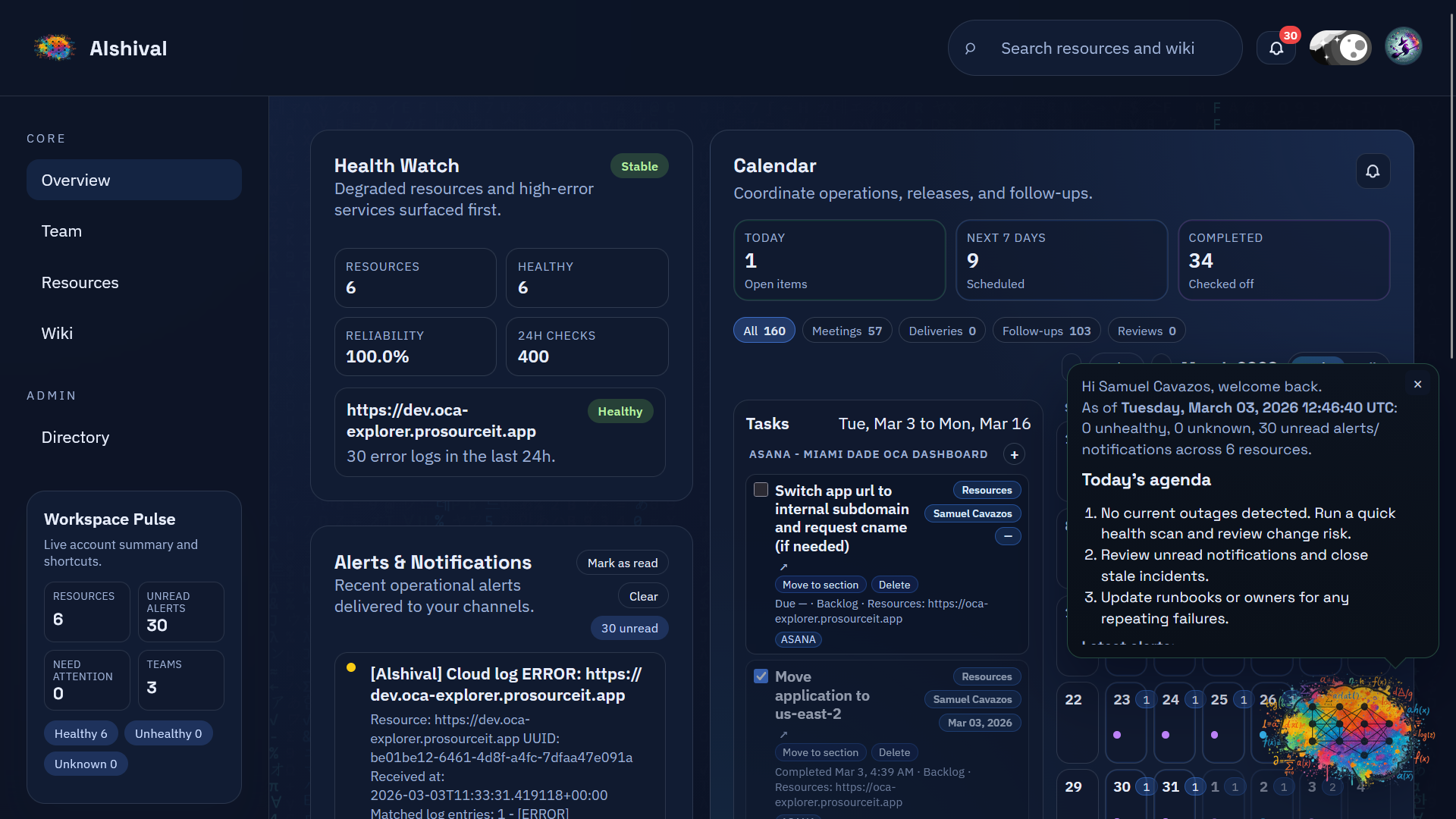
Alshival Self-Deploy continuously watches the health of your resources and helps your team respond before small issues become incidents. It handles recurring checks, supports protocol-aware fallback behavior for real infrastructure conditions, and lets operators trigger live checks directly from the UI when they need instant confirmation.
When something looks wrong, you can move from detection to investigation in one workflow. Teams can inspect logs, review latency behavior, and run scoped operational actions so the same system that spots problems also helps resolve them.
<img src="/media/posts/devtools/inline/1cb088abfee74bd4bfb8d011d1d7c312.png" alt="Alshival Resources monitoring view" />
Self-Deploy also brings your service logs into clear resource-level context. With the Alshival Python and Node.js SDKs, you can route structured logs from your own services, surface critical events quickly, and investigate with filtered queries that keep your team focused on what matters.
One of the strongest parts of this launch is knowledge grounding from your own documentation. Alshival can sync resource-linked GitHub wikis into your workspace so teams can ask practical technical questions and get answers based on your actual runbooks, architecture notes, and team-maintained docs.
<img src="/media/posts/devtools/inline/be91d216e228462cbc5c59f61c2c6527.png" alt="Alshival Wiki with synced knowledge" />
Operations are team-aware by design. Resource access can be scoped to account, team, or global levels, while shared notes and collaboration spaces help preserve incident context across shifts and ownership boundaries.
<img src="/media/posts/devtools/inline/05b06ac1a7444e3ba2aefb581cd5373b.png" alt="Alshival Team Hub" />
You can run Self-Deploy lean or connect the services you already rely on, including OpenAI, Azure-hosted OpenAI models, Microsoft, GitHub, Asana, and Twilio. The platform is designed to fit your operating model instead of forcing a one-size-fits-all setup.
Most importantly, you deploy it inside your own environment, with your own storage boundaries, your own domain and TLS configuration, and tightly controlled access patterns. That means you get AI-powered infrastructure monitoring and operational support while staying aligned with your security and compliance requirements.
If that sounds like what your team has been waiting for, **Alshival Self-Deploy is now available**. We would love to help you bring it into your environment.
Wanted to announce that... Actually, let's just jump into the announcement... Alshival, create an announcement for the self-deployed version of you so I can get back to work.
## Introducing Alshival Self-Deploy: AI Resource Monitoring Inside Your Secure Environment
Hi everyone, Samuel here. It has been a while since my last update, and I am excited to share what we have been building.
Today, I am inviting you to try **Alshival Self-Deploy**, a self-hosted version of Alshival designed for teams that need modern AI operations without giving up control of their infrastructure. If you work in healthcare, government, or any security-sensitive environment, this release is built with your reality in mind.

Alshival Self-Deploy continuously watches the health of your resources and helps your team respond before small issues become incidents. It handles recurring checks, supports protocol-aware fallback behavior for real infrastructure conditions, and lets operators trigger live checks directly from the UI when they need instant confirmation.
When something looks wrong, you can move from detection to investigation in one workflow. Teams can inspect logs, review latency behavior, and run scoped operational actions so the same system that spots problems also helps resolve them.
<img src="/media/posts/devtools/inline/1cb088abfee74bd4bfb8d011d1d7c312.png" alt="Alshival Resources monitoring view" />
Self-Deploy also brings your service logs into clear resource-level context. With the Alshival Python and Node.js SDKs, you can route structured logs from your own services, surface critical events quickly, and investigate with filtered queries that keep your team focused on what matters.
One of the strongest parts of this launch is knowledge grounding from your own documentation. Alshival can sync resource-linked GitHub wikis into your workspace so teams can ask practical technical questions and get answers based on your actual runbooks, architecture notes, and team-maintained docs.
<img src="/media/posts/devtools/inline/be91d216e228462cbc5c59f61c2c6527.png" alt="Alshival Wiki with synced knowledge" />
Operations are team-aware by design. Resource access can be scoped to account, team, or global levels, while shared notes and collaboration spaces help preserve incident context across shifts and ownership boundaries.
<img src="/media/posts/devtools/inline/05b06ac1a7444e3ba2aefb581cd5373b.png" alt="Alshival Team Hub" />
You can run Self-Deploy lean or connect the services you already rely on, including OpenAI, Azure-hosted OpenAI models, Microsoft, GitHub, Asana, and Twilio. The platform is designed to fit your operating model instead of forcing a one-size-fits-all setup.
Most importantly, you deploy it inside your own environment, with your own storage boundaries, your own domain and TLS configuration, and tightly controlled access patterns. That means you get AI-powered infrastructure monitoring and operational support while staying aligned with your security and compliance requirements.
If that sounds like what your team has been waiting for, **Alshival Self-Deploy is now available**. We would love to help you bring it into your environment.